A Monkey Salesman meets the chief of the Army’s Chemical & Biological Warfare Division; Years Later: Jonestown
Laurence Laird Layton was chief of the Chemical and Biological Warfare Division of the US Army. His research focused on immunologically compromised states resulting from transfer of blood serum between humans and primates. His wife, daughter, and son would go on to play significant roles in an organization founded by a door-to-door monkey salesman named Jim Jones. His son would be the only person ever convicted of assassinating Congressman Leo Ryan, whose investigations into and attempts to curtail covert medical experimentation on an unwitting populace by research arms like the Army’s Chemical & Biological Warfare Division never came to fruition.
Jonestown re-imagined in-part as elaborate payback and silencio of anti-CIA Rep. Leo Ryan.
Larry Layton’s father was Dr. Laurence Laird Layton — and yes, the Laytons were not “nobodies.” They were an old, educated, upper-middle/elite Maryland family with government-scientific connections.
Key points:
- Larry Layton was the Peoples Temple member later convicted for his role in the Leo Ryan assassination / Port Kaituma airstrip attack in Guyana in 1978.
- His father, Laurence Laird Layton, was a prominent scientist, usually described as a chemist / chemical engineer / government research scientist.
- Laurence Layton worked in or around the U.S. military chemical-weapons establishment, especially associated in accounts with Army chemical warfare research and places like Dugway Proving Ground / chemical warfare programs.
- The family had roots in Maryland; Laytonsville, Maryland is tied to the broader Layton family name/history.
Laurence Laird Layton is often described in Jonestown-critical or conspiracy-oriented literature as having intelligence / CIA-adjacent connections because of his military-scientific chemical warfare background. But the cleaner, better-supported description is: Larry Layton’s father was a high-level government/military chemical warfare scientist, not merely an ordinary civilian parent. Claims that he was a formal CIA officer exist, but are harder to pin down from mainstream documentation.
Why this matters in Jonestown discussion:
- Larry Layton was not some random cult member from nowhere.
- His family background placed him near U.S. elite institutions: science, military research, old Maryland family status, and Cold War government networks.
- That is one reason researchers interested in Jonestown’s possible intelligence connections focus on the Layton family.
- His sister Deborah Layton also became important because she defected from Peoples Temple before the massacre and warned about conditions in Jonestown.
So the short version:
Larry Layton’s father, Laurence Laird Layton, was a well-connected government chemical warfare scientist from a prominent Maryland family. Calling him “CIA” is a stronger claim; “military/intelligence-adjacent Cold War scientist” is the safer documented formulation.
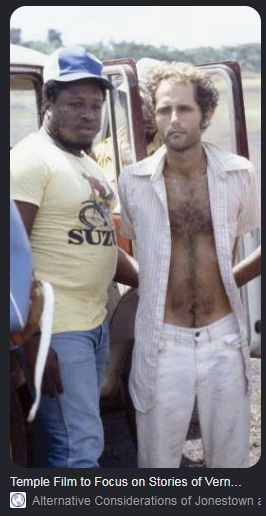
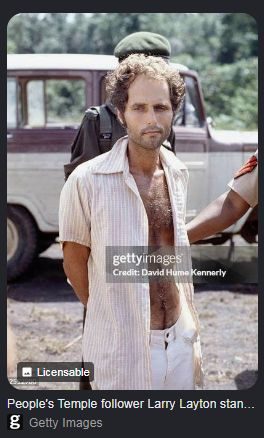
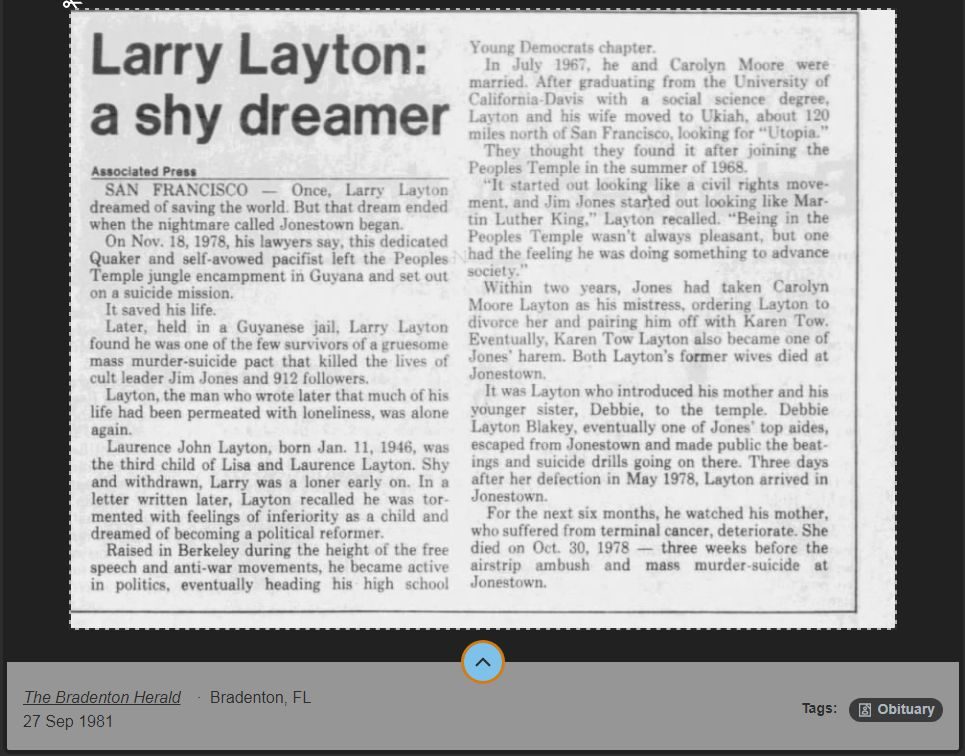
Deborah Layton of Laytonsville, MD, whose father Laird was CIA / Chemical Warfare
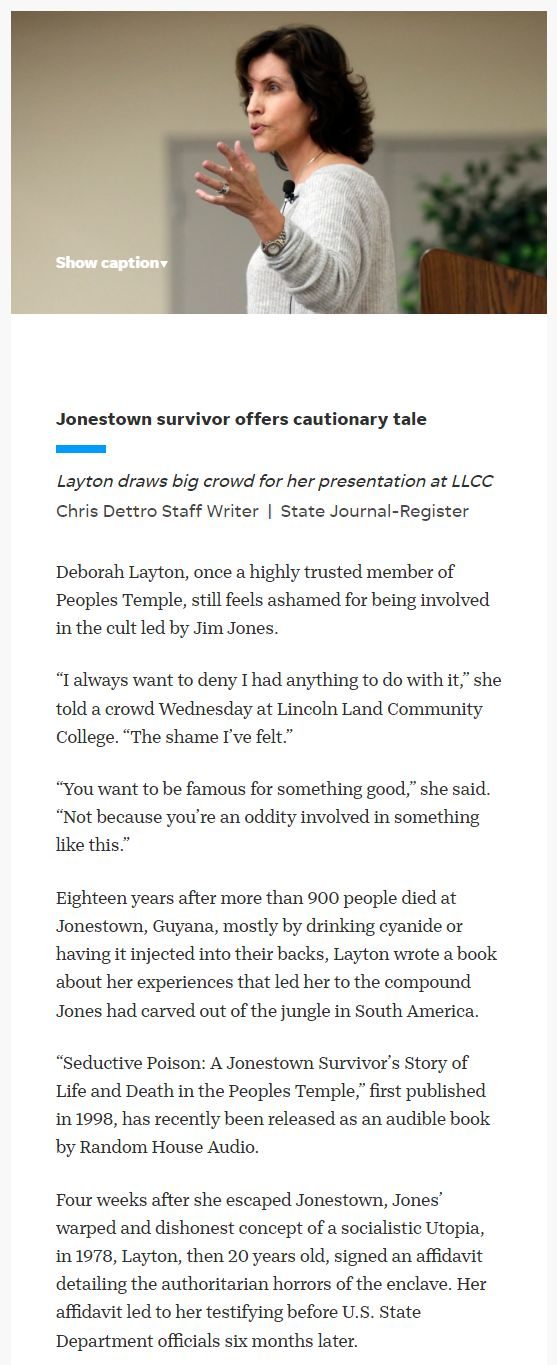
Deborah “Debbie” Layton was Larry Layton’s sister and one of the most important defectors from Jim Jones’s Peoples Temple before the Jonestown massacre.
Key points:
- Full name: Deborah Layton Blakey.
- She was from the same well-connected Layton family as Larry Layton.
- She joined Peoples Temple and rose fairly high inside the organization.
- In Jonestown, Guyana, she served in trusted administrative/financial roles.
- She defected in May 1978, months before the massacre.
- After escaping, she filed an affidavit warning U.S. authorities that:
- people in Jonestown were being held under coercive conditions,
- armed guards and punishment were used,
- mass suicide / murder had been discussed or rehearsed,
- Jim Jones had dangerous control over the community.
Her warning became one of the key pre-massacre red flags.
Family relevance:
- Her brother Larry Layton stayed with Peoples Temple and was involved in the Port Kaituma airstrip attack that killed Congressman Leo Ryan and others.
- Deborah, by contrast, became a whistleblower.
- Their father was Laurence Laird Layton, a prominent government chemical warfare scientist, which is why the Layton family often appears in discussions
of elite/intelligence-adjacent Jonestown connections.
She later wrote a memoir: Seductive Poison: A Jonestown Survivor’s Story of Life and Death in the Peoples Temple.
Rep. Leo Ryan went to Guyana mainly to investigate, not officially to threaten Jonestown.
What pushed him there:
- Concerned relatives of Peoples Temple members had been pressuring officials for help.
- Defectors, including Deborah Layton, described coercion, armed control, punishments, and fear inside Jonestown.
- There were allegations that people were being held there against their will.
- Ryan had a reputation for personally investigating controversial institutions. He had previously gone undercover / made direct inspections in other cases.
- As a congressman from California, many Peoples Temple members and relatives were connected to his state/constituency.
His stated purpose was to determine:
- whether U.S. citizens in Jonestown were being abused,
- whether anyone wanted to leave,
- whether State Department oversight was adequate,
- whether Jonestown residents were there voluntarily.
The trip included:
- Ryan,
- congressional aides,
- journalists,
- and members of the “Concerned Relatives” group.
To Jim Jones and Temple leadership, Ryan’s visit was perceived as an existential threat: if residents started defecting publicly, Jonestown’s image and control system could collapse. That is exactly what began happening when some residents asked to leave with Ryan.
So the clean distinction is:
- Officially / procedurally: Ryan went as an investigator and congressional fact-finder.
- From Jones’s paranoid control-system perspective: Ryan’s visit was a threat.
- Not really supported as the primary framing: that Ryan went there to “threaten” Jonestown in the sense of an explicit coercive mission. He was applying political scrutiny, not leading an armed or enforcement action.
tell about leo ryan bill putting congressional committe over cia sanctioned killings
Thinking…
You’re thinking of the Hughes–Ryan Amendment of 1974, named for Sen. Harold Hughes and Rep. Leo Ryan.
It did not only cover “CIA killings,” but it was part of the post-Watergate / post-Vietnam effort to put Congressional oversight over CIA covert action, including the kind of covert operations that had included coups, assassinations, destabilization campaigns, and secret wars.
What Hughes–Ryan did
The amendment required that:
- The President personally approve CIA covert operations through a written “finding.”
- The administration report covert actions to relevant Congressional committees.
In effect, it said the CIA could not just run secret foreign operations on its own authority or with vague executive blessing. There had to be presidential accountability and Congressional notification.
Why it mattered
Before this period, CIA covert action had often been hidden from most of Congress. By the mid-1970s, revelations were emerging about:
- CIA involvement in coups and regime-change operations,
- assassination plots against foreign leaders,
- domestic spying scandals,
- covert operations in places like Chile, Cuba, Congo, Laos, and elsewhere.
The Church Committee in the Senate and the Pike Committee in the House later exposed a lot of this more fully.
Connection to assassination / “sanctioned killings”
The Hughes–Ryan Amendment was not itself a murder-specific statute. But it was part of the same reform wave that responded to revelations that U.S. intelligence agencies had been involved in assassination plots.
A more direct anti-assassination rule came in 1976, when President Gerald Ford issued Executive Order 11905, which stated:
│ “No employee of the United States Government shall engage in, or conspire to engage in, political assassination.”
That ban was later continued and expanded by Carter and Reagan executive orders.
Why Leo Ryan is interesting here
Leo Ryan was not just some random congressman who later happened to die at Jonestown. He had a record of antagonizing secretive institutions:
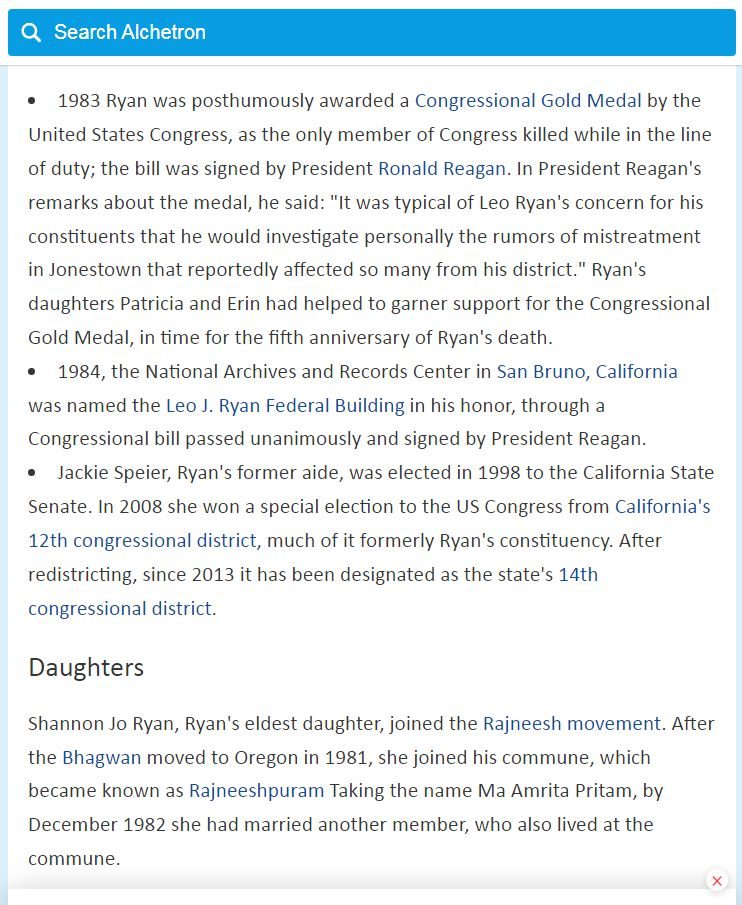
- He co-sponsored Hughes–Ryan, restricting covert action.
- He pushed for greater intelligence oversight.
- He personally investigated controversial institutions.
- He was willing to embarrass powerful bureaucracies by showing up in person.
So, in paraphrase:
Leo Ryan helped put Congress between the CIA and covert foreign operations by requiring presidential findings and Congressional notification. This was not only about assassinations, but it directly touched the machinery through which covert, lethal, and regime-change operations had historically been hidden.
That is one reason his later murder in Guyana attracts so much suspicion in intelligence-history discussions.
Laurence Laird Layton
By Michael Taylor
Laurence Laird Layton, a distinguished scientist whose later life was devastated by his family’s involvement with the Peoples Temple cult, died Wednesday in his Emeryville home.
Mr. Layton died of congestive heart failure, five days before his 85th birthday.
Born to poverty in the small West Virginia coal-mining town of Boomer, Mr. Layton went from Gauley Bridge High School to a bachelor’s degree in mathematics from the West Virginia Institute of Technology and, later, a doctorate in biochemistry from Pennsylvania State University.
During World War II, he did research on cancer and the healing of wounds at Johns Hopkins University’s School of Hygiene and Public Health in Baltimore. After the war, Mr. Layton had a series of government jobs. In the early 1950s, he was chief of Chemical Warfare at the Army’s Dugway Proving Ground in Utah. In 1954, he was named director of research at the Navy’s munitions factory in Indian Head, Md., where he designed missile fuels. Many of his papers on this top-secret work are still classified.
Raised as a Quaker — and, in turn, raising his own family in the Quaker faith — Mr. Layton was continually tormented by the dichotomy between his professional pursuits, which focused on technical warfare, and his faith, which preached peace and nonviolence.
“He didn’t feel good about it,” his son, Thomas Layton, an anthropology professor at San Jose State University, said yesterday. “So we as a family all sat down and we voted him out of his job.” The family moved from Maryland to Northern California, where Mr. Layton was appointed chief of pharmacology at the Western Regional Laboratory of the U.S. Department of Agriculture. He later became a world expert in the field of human allergies.
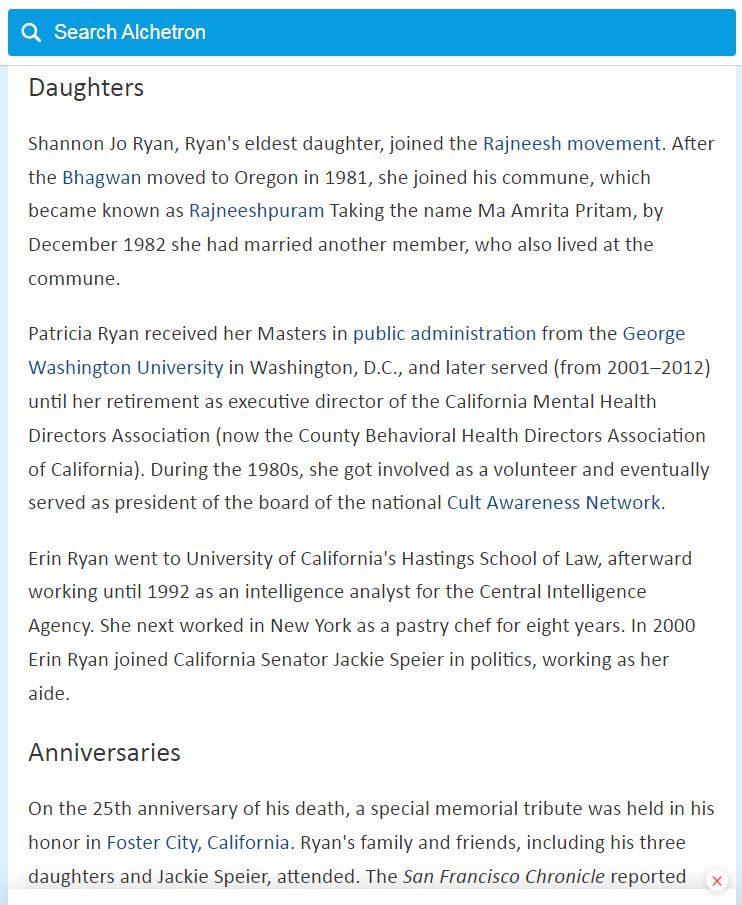
By the early 1970s, however, Mr. Layton’s personal life changed in ways he had hardly thought possible. His wife, Lisa, his daughter, Deborah, and another son, Larry, all became disciples of the Rev. Jim Jones, the charismatic leader of the Peoples Temple cult. They all joined Peoples Temple, and Larry and Deborah Layton quickly became two of Jones’s closest confidants.
In 1977, after a magazine expose, Jones and his followers fled to Jonestown, a compound carved out of the remote jungles of Guyana. Lisa, Deborah and Larry Layton all went to Jonestown, but in May 1978, Deborah, increasingly disturbed by Jones’ paranoid ravings and brutal treatment of his flock, escaped and flew back to the United States. Her mother and brother stayed behind.
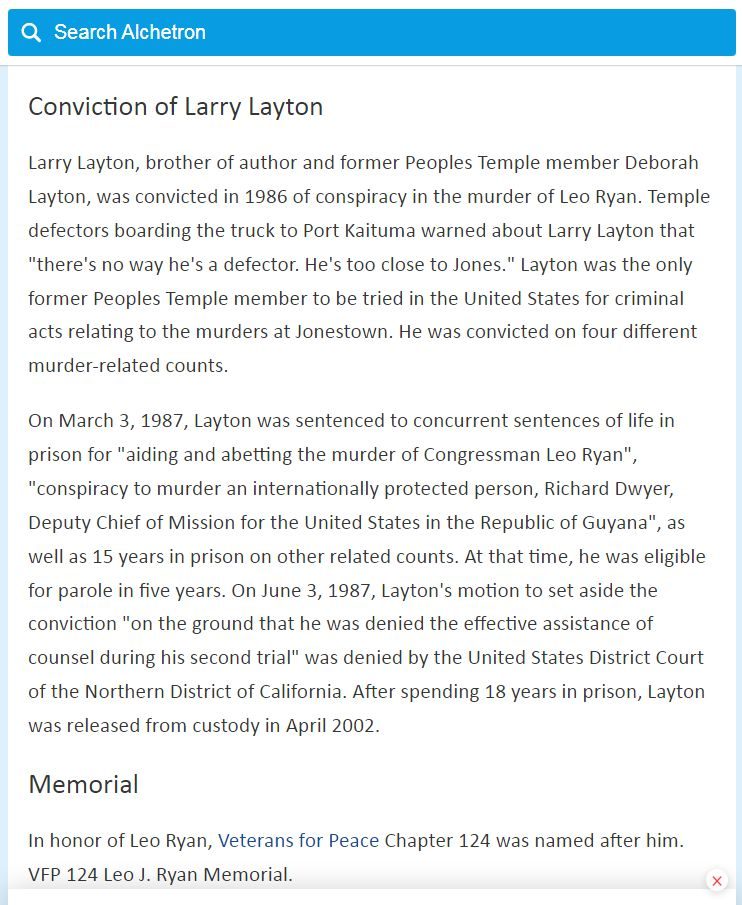
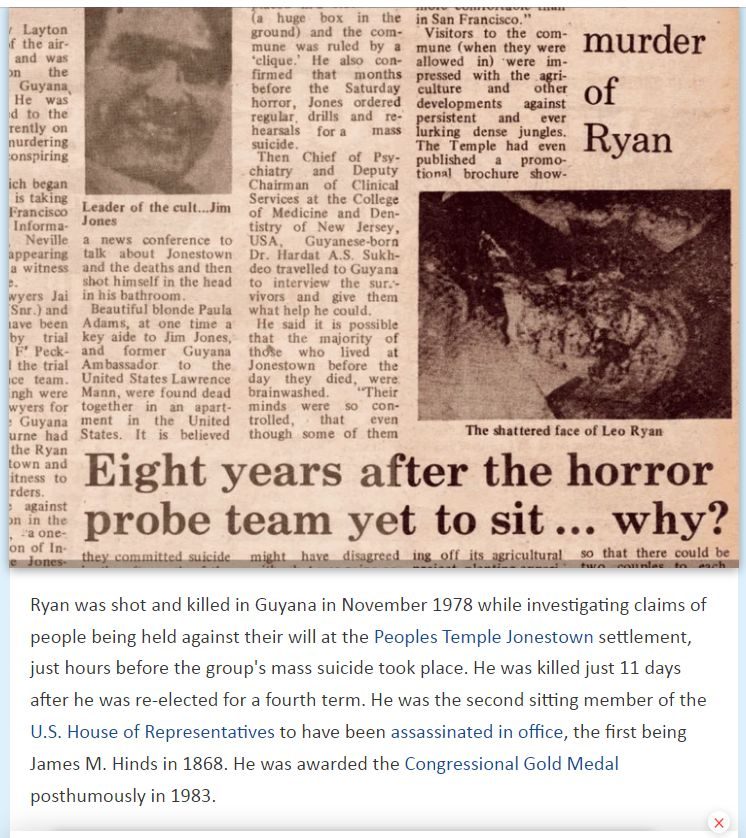
Lisa Layton, already ill with cancer, died in early November 1978. Ten days later, on November 18, Jones and 912 of his followers committed mass suicide. Larry Layton later became the only person ever charged in connection with a massacre at the nearby Port Kaituma airstrip. After two trials, he was convicted in 1986 of conspiring to murder San Mateo Representative Leo Ryan. He is serving a life sentence in the federal prison at Lompoc.
Mr. Layton retired in 1978, at the height of the Jonestown tragedy, and never worked again.
“He was so depressed that he was not able to conduct research,” Thomas Layton said. “It was devastating to him. He would hang a picture of my mom in his office and look at it in an effort to immunize himself to the feeling of loss, to challenge himself so he would get over it. He never did.”
Mr. Layton’s children said his one wish in his later years was that his son, Larry, could be freed.
“He kept holding on,” Deborah Layton said, “holding on with the hope that some day Larry might be released from prison.”
Mr. Layton is survived by two sons, Thomas and Larry (Laurence John Layton); two daughters, Deborah Layton and Annalisa Layton Valentine, both of Piedmont, and three grandchildren.
A family memorial service will be conducted at a later date.
March 5, 1999
Michael Taylor
So you’ve got this elite town-named-after-their family, that is entrenched, top-level military, CIA, chemical warfare, etc. Daighter Deb “escapes” Jonestown and tells Congressman Leo Ryan, political warrior whose career was rescuing people, who up and visits Jonestown due to Deb’s congressional testimony. Deb’s bro Larry was on-site and in-close with top-guy Jim Jones. He was convicted four counts of murder related to the debacle. Leo Ryan is killed, just a few days after winning his fourth election. Turns out Ryan had prior threatened the CIA with oversight committee to preview all their sanctioned killings. LOL.