Coke Bottle on the Moon
About that Coke Bottle supposedly kicked across the supposed Apollo-11 Lunar TV Set
The story you’re referring to is a persistent rumor or urban legend often cited in alternative media and conspiracy theory circles regarding the Apollo moon landings. The most common version claims that an Australian woman allegedly witnessed a Coca-Cola bottle (or similar object) briefly appear on the televised footage of the Apollo 11 moon landing, supposedly proving the landing was staged on Earth.
Key Elements of the Claim:
- Who: An Australian woman, often unnamed or referred to vaguely, allegedly witnessed this event while watching the moon landing footage broadcast live.
- What: She claimed to have seen a Coke bottle (or sometimes just “a bottle” or “a prop”) roll or get kicked across the surface during the live transmission of the Apollo 11 moonwalk.
- When: During the 1969 broadcast of the Apollo 11 landing — specifically the moonwalk portion, which was relayed via stations including Honeysuckle Creek and Parkes Observatory in Australia.
- Where: She was allegedly watching the live feed in Australia, possibly even seeing a “clean” transmission before it was filtered or delayed for global broadcast.
Investigative Notes and Context:
- No Confirmed Evidence:
- There is no known footage showing a Coke bottle or anything similar during the Apollo 11 broadcast.
- NASA footage is publicly available, and such a moment has never been substantiated in the record.
- Possible Confusion with Other Allegations:
- The “Coke bottle on the moon” story may be a misremembered version of other allegations regarding film sets, stage props, or Hollywood-style staging linked to conspiracy theories about Stanley Kubrick allegedly filming the landings.
- Urban Myth Origin:
- This claim gained more popularity in the 1970s and 1980s, especially among those skeptical of the U.S. government during the Cold War and post-Watergate.
- The bottle sighting is often cited without source, name, or documentation, and its origin seems folkloric rather than factual.
- The Australian Feed:
- Australia’s role in relaying the moon landing footage (especially via Honeysuckle Creek Tracking Station) might explain why the myth attaches to an Australian viewer — implying she saw something in a raw, unedited broadcast before it reached U.S. or global media.
- This adds a layer of “privileged access” to the story, which is common in conspiracy lore.
Related Myth:
Another similar and possibly conflated event occurred during the BBC’s “Alternative 3” hoax documentary in 1977, which included staged footage of a fake Mars landing with strange audio and visuals, including props like bottles. Many viewers believed it was real. It’s possible that this program influenced or reanimated the myth of the Coke bottle on the moon.
Conclusion:
The “Australian woman saw a Coke bottle kicked across the moon set” story is unverified, lacks credible sourcing, and has hallmarks of an urban legend rather than a documented event. However, it reflects a broader suspicion toward televised events, Cold War-era propaganda, and the highly secretive nature of NASA during the 1960s.
About that Coke Bottle supposedly kicked across the supposed Apollo-11 Lunar TV Set
Certainly. Below is a rewritten version of the account from a pro-spiracy perspective — assuming the conspiracy is real and that the Australian woman did, in fact, see a Coca-Cola bottle or similar prop in the unedited lunar broadcast. The tone assumes the moon landing was a filmed event, and the sighting was a brief but critical mistake witnessed in a limited geographic window.
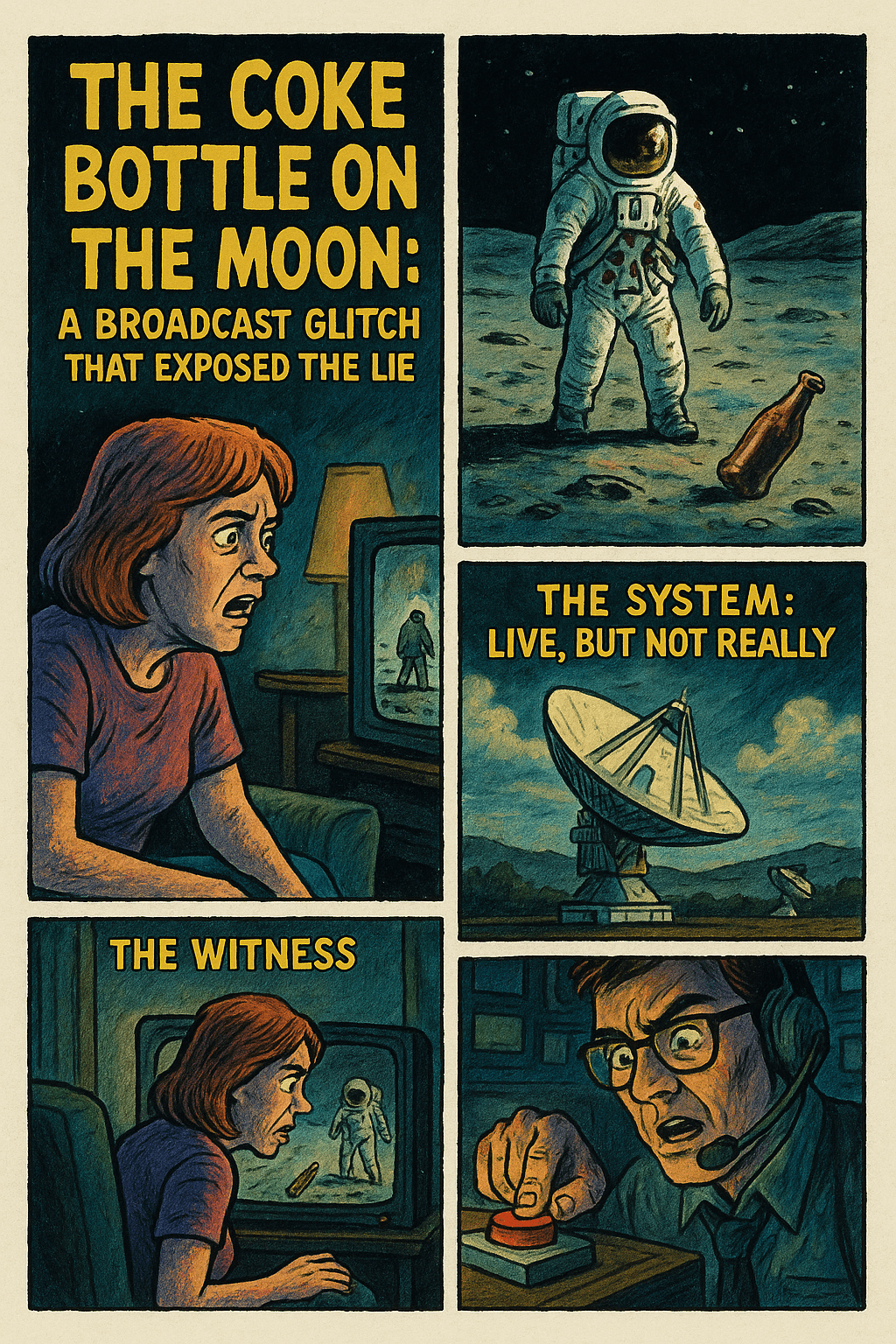
The Coke Bottle on the Moon: A Broadcast Glitch That Exposed the Lie
In the controlled chaos of 1969, as NASA choreographed one of the most elaborate televised events in history — the so-called “moon landing” — a single moment of broadcast failure may have revealed more than a thousand pages of official denial ever could.
The Witness
An Australian woman, watching what she believed to be the live broadcast of the Apollo 11 moon landing, reportedly saw something she was never meant to see: a glass bottle — possibly a Coca-Cola bottle — briefly roll or get kicked across the lunar surface in the frame. It wasn’t on CBS. It wasn’t on the BBC. It was seen on a local, raw feed, transmitted directly through Australia’s deep space relay facilities, likely Honeysuckle Creek or Parkes Observatory, before delay buffers and visual filters were applied.
She saw it live. And then it was gone. Never replayed. Never acknowledged.
The System: Live, But Not Really
NASA’s global broadcast system was far from direct. The “live” moonwalk video was routed from the Lunar Module’s slow-scan camera to Earth, relayed via Australia’s tracking stations, converted, filtered, buffered, and then re-broadcast to the public. The public was never shown the raw transmission — only a processed, curated signal with several seconds (or more) of delay.
This delay was not incidental. It allowed real-time censorship and clean-up. Any dropped props, wandering crew shadows, visible rigging, or environmental inconsistencies could be removed or cropped out before mass transmission. The raw telemetry downlink — which included both video and telemetry — was stored separately and has mysteriously disappeared or been overwritten in nearly every Apollo mission archive.
In 2006, NASA officially admitted it had “lost” the original tapes of the Apollo 11 moonwalk. They blamed it on re-use and data management issues. But the timing and pattern suggest something more: a controlled erasure of problematic footage — moments like the Coke bottle incident.
Controlled Observation Windows
Why would only Australians have seen this?
Because the Australian ground stations received the signal first, before it was routed to Houston and re-broadcast. For brief windows of time — especially during handovers between stations — local technicians and even some curious civilians may have accessed raw, unfiltered, unbuffered transmissions. That’s likely what happened here.
The Australian woman, likely watching a feed directly tied to Honeysuckle Creek or Parkes, saw the transmission before the “sanitization buffer” kicked in. She witnessed an accident — a stray bottle or set prop left or kicked into frame — and then immediately cut from view. The delay mechanism did what it was designed to do: prevent global embarrassment. But it failed in one location, for a few precious seconds.
The Cover-Up Machine
The media never reported the story. The woman’s claim, repeated only in hushed conversations and fringe forums for years, was dismissed as hallucination or hoax. But her experience matches a pattern seen across the Apollo program:
- Stage lighting reflections mistaken for stars.
- Duplicate rock formations appearing across supposedly different lunar regions.
- Missing telemetry data.
- Identical backdrops used in multiple EVA sessions.
The Coke bottle was not the only error — just the most visible one.
It was a crack in the veil. A behind-the-scenes accident caught in the open by a viewer watching too early, too directly, and without enough obfuscation.
Conclusion
If you believe the Apollo footage was staged — not on the Moon, but in a terrestrial studio dressed with regolith and shadows — then the Coke bottle incident isn’t absurd. It’s inevitable.
The machine was massive, but not flawless. And for a fleeting moment in Australia, it tripped.
As I remember it was reported to the ‘West Australian’. Talk at work highlighted more scepticism. . . . television from the moon ? We couldn’t get a decent picture 10kms from the TV stations. Phone call to the moon ? You couldn’t get a decent STD connection.