Operation Gladio: Proven Architecture of State Subversion, Political Control, and Managed Public Fear
SECTION 1. WHAT “GLADIO” IS
Operation Gladio is the proven, documented system of secret NATO-aligned “stay-behind” armies created in Western Europe after World War II. These covert networks were built, supplied, and coordinated by U.S. and British intelligence (CIA and MI6), operating through NATO, and embedded within national militaries and intelligence services in countries such as Italy, Belgium, West Germany, France, the Netherlands, Greece, and Turkey.1 These forces were armed, trained, and maintained in deep secrecy for decades. Weapons caches, communications infrastructure, and personnel lists were kept outside normal democratic oversight. Prime ministers, parliaments, and even many senior officials were not informed. The stated cover story was that these units would resist a future Soviet invasion. In practice, the mission extended to shaping and controlling domestic politics through subversion, psychological warfare, and manufactured violence, all under the logic of stopping left-wing or “unreliable” movements from gaining power.1
In October 1990, Italian Prime Minister Giulio Andreotti admitted to Parliament that Italy had such a clandestine structure — “Gladio” — including hundreds of recruited civilians and at least 127 weapons caches.2 This forced other NATO states to acknowledge parallel structures. In November 1990, the European Parliament condemned the existence of these clandestine armies and warned that they had operated “for 40 years … outside all democratic controls,” intervening illegally in domestic affairs.1 The existence of Gladio is therefore not theoretical. It is formally admitted, condemned at the European institutional level, and historically established in mainstream reporting.1 (Wikisource)
SECTION 2. ORIGINS AND STRUCTURE (OSS → CIA → NATO)
Gladio’s roots go back to the end of World War II. The U.S. Office of Strategic Services (OSS), the CIA’s predecessor, had built anti-Communist networks among fascist, nationalist, and intelligence circles in Europe. After the war, instead of dismantling these networks, the CIA and MI6 reactivated and formalized them as “stay-behind” units.2 By the late 1940s and 1950s, these secret armies were being financed, trained, and coordinated by U.S./UK intelligence with direct integration into Western European militaries. By 1959, they were being coordinated through NATO committees that quietly met with U.S. representatives present in an “observer” role that in reality shaped direction.2
The cells recruited ideologically reliable hardliners — often ultra-nationalists, sometimes open fascists or former Nazi collaborators — considered willing to do deniable work against the political left.3 Each country’s program carried a codename (e.g. “Gladio” in Italy), but the structure was international: a standardized, NATO-linked underground parallel force designed to activate in crisis, with its own chain of command and its own arsenals.2 When Andreotti disclosed Gladio in October 1990, he also provided a partial roster of hundreds of civilian operatives prepared to act on command. He made clear that these forces were embedded in military intelligence and linked to an Allied Clandestine Committee coordinating across multiple NATO countries.2 (The Washington Post)
SECTION 3. STRATEGY OF TENSION: HOW GLADIO OPERATED
By the late 1960s, Gladio’s mission had expanded from “resistance planning” into direct manipulation of domestic politics through fear. This doctrine is known as the “strategy of tension.” Its core method is simple:
- Create or allow violent shocks — bombings, massacres, assassinations, riots, targeted killings.
- Blame those attacks on an internal enemy (leftists, unionists, radicals, minorities).
- Amplify public fear through media until the population demands security and order.
- Deliver the “solution”: harsher policing, emergency powers, anti-left crackdowns, and consolidation of pro-NATO, pro-U.S. governance.3
Italian parliamentary investigations concluded in 2000 that this was not hypothetical. They found that massacres, bombings, and terror attacks in Italy in the 1960s–1980s “had been organized or promoted or supported by men inside Italian state institutions and … by men linked to the structures of United States intelligence,” with the explicit aim of preventing the Italian Communist Party (PCI) and related left formations from ever reaching executive power.3 The same report stated that U.S.-linked personnel had advance knowledge of major bombings — including the 1969 Piazza Fontana bombing in Milan and the 1974 Piazza della Loggia bombing in Brescia — and did nothing to stop them.3 This is textbook Hegelian problem→reaction→solution: engineer terror, steer public emotion, impose the preferred political order. (The Guardian)
SECTION 4. DOCUMENTED CASES (ITALY, BELGIUM, TURKEY)
A. Italy (“Years of Lead”)
Italy provides the cleanest forensic record.
– Peteano bombing (May 31, 1972): A car bomb killed three Italian Carabinieri. Authorities immediately blamed the extreme left. Years later, Judge Felice Casson reopened the case and discovered secret military intelligence files proving that the bomb was placed by a neo-fascist militant (Vincenzo Vinciguerra) tied into Gladio-linked structures. The explosive material matched clandestine Gladio arms caches, and investigators had been deliberately steered to frame leftists.4
– Piazza Fontana (December 12, 1969), Piazza della Loggia (May 28, 1974), Bologna station (August 2, 1980): These mass-casualty bombings were initially pinned on anarchists or Communists. Parliamentary and judicial work later traced operational responsibility toward far-right networks protected by segments of Italian intelligence. Italian magistrates such as Guido Salvini described these extremist cells as “trench troops of a secret army linked to the CIA,” and said the American role ran from prior knowledge to tacit inducement of atrocities.3
This is not speculation. It is supported by Italian court findings, parliamentary commissions, and direct testimony of convicted operatives like Vinciguerra, who openly described a state-protected network that carried out killings and then blamed the left so the public would accept authoritarian measures.3 (The Guardian)
B. Belgium (the Brabant massacres)
Belgium in the early 1980s suffered a wave of supermarket massacres — masked gunmen storming grocery stores, executing civilians, sowing maximum terror. The killers were never officially “solved.” After Gladio was exposed in 1990, Belgium admitted it, too, had a secret stay-behind army. Parliamentary inquiries immediately asked whether the Brabant killings were part of the same strategy of tension: spectacular public violence, mass panic, and then political pressure for harsher internal security and expanded state force.2 (The Washington Post)
C. Turkey (Counter-Guerrilla)
Turkey’s branch of Gladio was known as “Counter-Guerrilla” (Kontrgerilla). It functioned as an anti-left, anti-Kurdish, deep-state apparatus, with torture, targeted assassinations, and direct involvement in the 1971 and 1980 military coups. Former Turkish Prime Minister Bülent Ecevit publicly acknowledged the existence of this “secret army” in the 1970s. Researchers have documented that Counter-Guerrilla personnel were tied to paramilitary death squads and that this network helped justify brutal crackdowns framed as restoring national order. The structure was explicitly linked to NATO’s stay-behind architecture and backed under U.S. Cold War policy.[10] (Libcom)
SECTION 5. WHO RAN IT AND WHY
Gladio was run by a coalition of:
– CIA (and previously OSS), supplying money, logistics, training, political guidance.
– MI6, coordinating with the CIA on recruitment and covert assets.
– NATO command committees, which provided multinational cover and continuity.
– Domestic intelligence and military services (e.g. Italy’s SID/SISMI, Belgium’s military security, Turkey’s Counter-Guerrilla), which actually recruited and handled operatives.
– Far-right, ultra-nationalist militants and ex-fascists who were ideologically committed to violent anti-Communism and therefore considered “reliable.”2[10]
The motive was to prevent any socialist, Communist, neutralist, or otherwise “uncontrolled” faction from taking actual governing power in Western Europe (or allied states like Turkey), even through normal elections. The U.S. position in the Cold War was that a left-wing electoral win in, for example, Italy in the 1960s–1970s was not a legitimate democratic event but a national security crisis. So the answer was to rig the climate. That meant covertly funding friendly parties, planting weapons, infiltrating and framing the left, and green-lighting “strategy of tension” operations that frightened the public into accepting authoritarian policing and pro-NATO leadership.24[10]
This is why Gladio is accurately described as a parallel state: it functioned alongside (and often above) formal democratic structures, using deniable force and psychological warfare to guarantee that the geopolitical alignment of a country stayed within U.S./NATO parameters.13 (The Washington Post)
SECTION 6. CONTINUATION AFTER THE COLD WAR (“GLADIO B”)
When the Soviet Union collapsed in 1991, the original anti-Communist justification was no longer available. Gladio was exposed publicly in 1990–1991, and European governments claimed to dismantle it.1 But the method survived.
Whistleblower testimony and independent investigations have described what is often called “Gladio B”: a post–Cold War continuation in which NATO-linked intelligence services allegedly cultivated and moved select Islamist extremist assets (including networks tied to figures later associated with Al Qaeda and regional radical groups) to destabilize strategic regions such as the Caucasus, Central Asia, and the Middle East after 1991. The purpose remained identical: engineer chaos, justify Western intervention, and block rival powers (especially Russia) from consolidating influence.[11]
Former FBI translator Sibel Edmonds has publicly described this model: U.S./NATO intelligence, together with elements of Turkey’s deep state, allegedly used Islamist proxies in the late 1990s and 2000s the same way earlier Gladio structures used fascist proxies in Europe — as deniable shock troops to produce crises that could be exploited geopolitically. This is presented not as a break with Gladio, but as its direct evolution.[11] (The Corbett Report)
SECTION 7. DOMESTIC PARALLEL: THE 1992 LOS ANGELES RIOTS
The 1992 Los Angeles riots followed the April 29, 1992 acquittal of LAPD officers who were videotaped beating Rodney King. The outrage in Black Los Angeles was real. But the handling of the first hours of unrest, the media framing, and the political aftermath show a Gladio-style pattern.
- Managed escalation: Law enforcement, especially LAPD command, initially pulled back instead of immediately suppressing flashpoint violence. Entire blocks were abandoned to looting, arson, and beatings in the opening window. Los Angeles County Sheriff Sherman Block later blasted LAPD’s early response, saying it “didn’t make any sense,” and that by failing to intervene quickly the police “lent an aura of legitimacy” to the looting.5 This stand-down allowed the city to visibly burn on live national television.5
- Psychological framing: National media then hammered a simplified racial narrative — heavily circulating footage of armed Korean-American shopkeepers on rooftops and street gunfights in Koreatown — presenting the event as an ethnic race war (Black vs. Korean) rather than a rebellion against systemic police brutality, economic abandonment, and state violence.6 Scholars have since documented how this framing diverted attention away from structural grievances and redirected rage laterally between communities.6
- Militarized “solution”: After days of chaos and billions in property damage, federal troops, federal agents, and the National Guard were deployed to restore order. The political result was not deep reform of LAPD, housing, wages, or policing culture. The result was a hardened “law and order” consensus that was later invoked to justify larger police budgets, more aggressive urban militarization, and harsher sentencing through the 1990s.57
This is the same problem→reaction→solution structure. The problem (urban explosion) is allowed long enough to terrorize the entire country on live TV. The reaction (public fear and racial division) is deliberately amplified. The solution (federal militarization and long-term “tough on crime” policy) is then normalized. Functionally, it mirrors Gladio doctrine even if it was executed through domestic police and federal forces rather than NATO stay-behind cells.57 (Los Angeles Times)
SECTION 8. DOMESTIC PARALLEL: MODERN ICE RAIDS
Mass-scale immigration raids in the United States under recent federal enforcement policy operate on openly stated psychological-warfare logic. Immigration and Customs Enforcement (ICE) has staged high-visibility, militarized raids on workplaces, homes, community spaces, and even restaurants, and then publicly amplified these actions in media to generate fear among undocumented communities.
On July 17, 2025, for example, coordinated raids hit multiple restaurants across Alabama. Federal agents publicly framed the operation as targeting “fraud” and serious crime. Immigrant-rights groups on the ground immediately called it a “false flag,” stating that the supposed criminal pretext was just cover for mass arrests of kitchen staff and line workers in order to satisfy deportation quotas. Advocates said openly that the real purpose was to “create fear and panic statewide” and terrorize Latino communities, not to neutralize an actual violent threat.[8]
This tactic is not hidden. The modern deportation agenda has been explicitly sold as a fear campaign. Legal and advocacy organizations have documented how federal leadership talks about making immigrant communities “afraid,” how raids are timed and publicized for maximum psychological shock, and how mass roundups regularly sweep up large numbers of non-criminal immigrants while being marketed as “public safety operations.”[9][8][12] Communities respond the way they are meant to respond: people avoid work, school, hospitals, and even church, living in a state of paralyzed insecurity after these raids.[10][8][9][12]
This is domestic strategy of tension. The state manufactures or theatrically exaggerates an “enemy within,” performs a militarized show of force, spreads fear through media, and then uses that fear to justify more paramilitary policing, more detention infrastructure, and more executive power over targeted populations. The logic and effect are Gladio-style: destabilize, divide, and rule through orchestrated terror pressure.[8][9][12] (Alabama Political Reporter)
SECTION 9. SUMMARY OF FINDINGS
- Gladio was (and is) a method, not just an organization. It is the doctrine of manufacturing or weaponizing crisis to steer society in a desired political direction.13
- During the Cold War, this doctrine was executed through clandestine stay-behind armies, coordinated by CIA/MI6/NATO, that used terror and false-flag operations to block left-wing or anti-NATO outcomes in Europe.13[10]
- Italian judicial investigations, Italian parliamentary commissions, and the European Parliament have openly stated that Gladio-linked personnel organized, supported, or protected bombings and massacres, and framed the left for them, to force a frightened public into accepting authoritarian “security.”14
- Turkey’s Counter-Guerrilla branch shows that Gladio tactics were exported to crush internal enemies, justify coups, and terrorize dissidents under the banner of “national security.”[10]
- After the USSR collapsed, the same architecture adapted: “Gladio B” used Islamist proxy networks in the 1990s–2000s to destabilize key regions and justify Western geopolitical moves.[11]
- Inside the United States, the same structural logic — managed escalation, media fear theater, and an immediately imposed “security solution” — can be seen in events like the 1992 Los Angeles riots and modern ICE raids. The target changes (inner-city Black communities, immigrant labor), but the mechanism is the same: problem → reaction → solution, directed from above.57[8][9][12]
Gladio is therefore not a rumor. Gladio is a template: covert or semi-covert force is applied to populations in order to frighten them, divide them, and drive them into accepting the exact crackdown the architects wanted from the start. That template is still in use.
SOURCES
1 “European Parliament resolution on Gladio,” European Parliament, November 22, 1990. The resolution condemns the discovery of clandestine stay-behind armies that operated for decades in multiple European states without democratic control and warns that they illegally interfered in internal politics. https://en.wikisource.org/wiki/European_Parliament_resolution_on_Gladio
2 Clare Pedrick, “CIA Organized Secret Army in Western Europe,” The Washington Post, November 14, 1990. This report describes how the CIA built secret paramilitary ‘stay-behind’ armies across Western Europe in the 1950s and details the political shock after Italian Prime Minister Giulio Andreotti admitted Gladio’s existence on October 24, 1990. https://www.washingtonpost.com/archive/politics/1990/11/14/cia-organized-secret-army-in-western-europe/e0305101-97b9-4494-bc18-d89f42497d85/
3 Philip Willan, “US ‘supported anti-left terror in Italy’,” The Guardian, June 24, 2000. Summarizes Italian parliamentary findings that bombings and massacres in 1960s–1980s Italy were organized, promoted, or protected by elements inside Italian state structures and men linked to U.S. intelligence, with the goal of blocking the Italian Communist Party. https://www.theguardian.com/world/2000/jun/24/terrorism
4 Daniele Ganser, “The Ghost of Machiavelli / An Approach to Operation Gladio and the Strategy of Tension,” ETH Zurich working paper (mid-2000s). Details Judge Felice Casson’s reopening of the 1972 Peteano bombing, proving it was carried out by a neo-fascist tied to Gladio networks and falsely blamed on the left, and explains how Italian security services redirected blame to justify repression. https://www.research-collection.ethz.ch/bitstreams/b31adeb7-9e04-44b0-b5b0-4e758646e947/download
5 “LAPD Response Made No Sense, Block Says,” Los Angeles Times, May 6, 1992. LA County Sheriff Sherman Block publicly condemns LAPD’s early stand-down during the April 29–May 4, 1992 Los Angeles riots, saying the lack of immediate police intervention “didn’t make any sense” and effectively legitimized the looting. https://www.latimes.com/archives/la-xpm-1992-05-06-mn-1247-story.html
6 “The ‘Roof Koreans’ Meme / The Collective Memory of Los Angeles,” Journal of Asian Studies, Vol. 84, No. 2, May 1, 2025. Analyzes how U.S. media framed the 1992 Los Angeles riots as a racial firefight between Black residents and armed Korean shopkeepers, hardening a racialized fear narrative and obscuring underlying structural causes. https://read.dukeupress.edu/journal-of-asian-studies/article/84/2/497/399020/The-Roof-Koreans-MemeThe-Collective-Memory-of-Los
7 “1992 Los Angeles riots,” summary of events including Koreatown self-defense, abandonment by LAPD, and televised rooftop gun battles; documents how national media portrayed the unrest as ethnic conflict and how federal troops and National Guard were ultimately deployed. https://en.wikipedia.org/wiki/1992_Los_Angeles_riots
[8] Jacob Holmes, “Immigrant advocacy group says ICE raid a ‘false flag’ to fill deportation quotas,” Alabama Political Reporter, July 17, 2025. Covers coordinated ICE raids on multiple Alabama restaurants and immigrant workplaces and quotes advocacy groups calling the operation a deliberate “false flag” meant to terrorize Latino communities and feed detention quotas. https://www.alreporter.com/2025/07/17/immigrant-advocacy-group-says-ice-raid-a-false-flag-to-fill-deportation-quotas/
[9] “Trump’s Mass Deportation Agenda Makes Everyone Less Safe — Including Immigration Agents,” American Immigration Council, October 17, 2025. Explains that current federal policy explicitly uses fear as a weapon: high-profile, militarized ICE raids and publicized arrest numbers are intended to frighten immigrant communities into self-removal and normalize paramilitary enforcement at home. https://www.americanimmigrationcouncil.org/blog/trump-mass-deportation-agenda-makes-everyone-less-safe-including-immigration-agents/
[10] Daniele Ganser, “NATO’s Secret Armies: Operation Gladio and Terrorism in Western Europe,” (London: Frank Cass, 2004) / widely circulated PDF “NATO’s Secret Armies.” Documents Turkey’s “Counter-Guerrilla” as the Turkish Gladio branch: U.S.-backed stay-behind forces involved in torture, assassinations, anti-left repression, and support for the 1971 and 1980 coups, openly acknowledged by Prime Minister Bülent Ecevit. https://files.libcom.org/files/NATOs_secret_armies.pdf
[11] James Corbett, “Episode 298 – Gladio B and the Battle for Eurasia,” The Corbett Report, December 2, 2014. Presents whistleblower Sibel Edmonds’ account that after 1991, NATO/CIA and elements of Turkey’s deep state retooled Gladio into “Gladio B,” using Islamist proxy networks to destabilize Central Asia and the Caucasus for geopolitical leverage. https://corbettreport.com/episode-298-gladio-b-and-the-battle-for-eurasia/
[12] “Immigration attorneys question ICE raids at Mexican restaurants, urge people to know their rights,” WBRC (Alabama), July 16, 2025, and Alabama community coverage of July 2025 raids. Reports that more than 40 restaurant workers were detained in multi-county raids; immigrant-rights groups describe the operation as theater meant to generate fear and compliance statewide rather than to neutralize serious criminal threats. https://www.wbrc.com/2025/07/17/immigration-attorneys-question-ice-raids-mexican-restaurants-urge-people-know-their-rights/
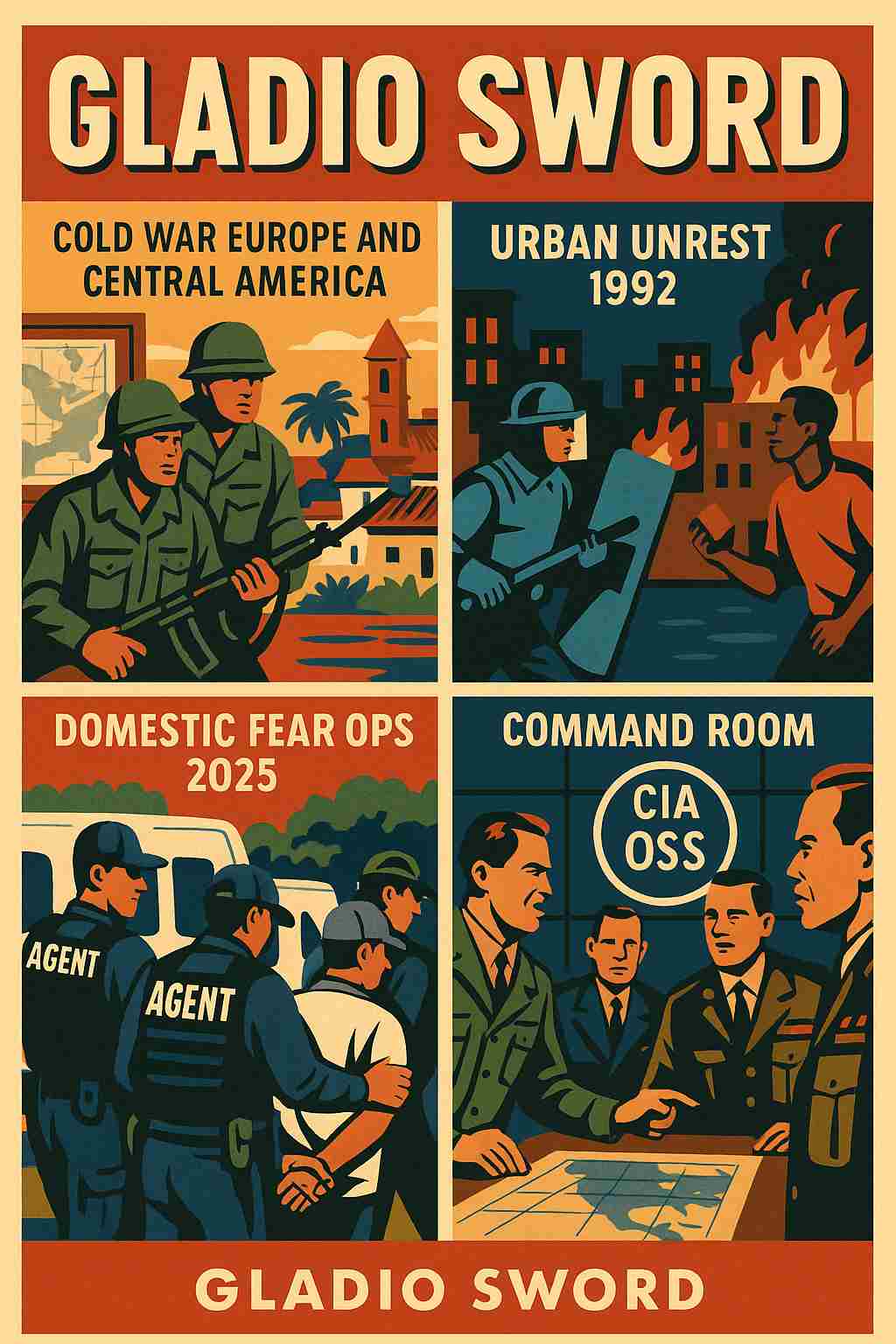
Operation Gladio: Proven Architecture of State Subversion, Control, and Psychological Warfare
1. What “Gladio” Is
Operation Gladio was the codename for a network of secret, NATO-aligned “stay-behind armies” established across Western Europe after World War II. These networks were built, funded, supplied, and coordinated by U.S. and British intelligence (primarily the CIA and MI6), operating through NATO command structures and select elements in each country’s military and intelligence services. Their stated purpose was to organize resistance in the event of a Soviet invasion. Their actual function expanded into domestic political manipulation, psychological warfare, and false-flag violence intended to steer democratic societies toward outcomes favorable to U.S./NATO interests.[1][2]
Cells existed in Italy (where the codename “Gladio” was first used, and later became shorthand for the entire program), Belgium, West Germany, France, Greece, the Netherlands, Turkey, and others, including officially “neutral” states like Switzerland and Sweden. These cells stockpiled weapons and explosives, maintained covert communication channels, and recruited ideologically reliable operatives — often ultra-nationalist and far-right militants, including ex-fascists and former Nazi collaborators — to be activated domestically when needed.[2][3]
Parliaments and prime ministers were generally not told. The structure existed in parallel to democratic government, with its own chain of command, hidden budgets, and armed capability. In 1990, when Gladio was publicly exposed, the European Parliament condemned the discovery of these secret armed networks, warned that they had interfered illegally in domestic politics, and protested that they operated entirely outside democratic oversight.[1]
Gladio was not hypothetical. It was formal, it was multinational, and it was coordinated. Its existence is admitted in official proceedings, and its mechanics have been documented in court testimony, parliamentary inquiries, and mainstream press investigations.[1][2][3]
2. How Gladio Formed: OSS → CIA → NATO
The roots go back to the final phase of World War II and its immediate aftermath. The U.S. Office of Strategic Services (OSS), predecessor to the CIA, had already cultivated anti-Communist assets among fascist, nationalist, and intelligence circles in Europe. After the war, these assets were not dismantled; they were repurposed.[2]
By the late 1940s and 1950s, the newly formed CIA, in cooperation with MI6, financed and organized secret Western European “stay-behind” structures. The logic was: if the Soviets invaded, these clandestine cells would wage guerrilla war behind enemy lines. But the mission quickly broadened. The CIA also poured money into anti-Communist political parties (for example, Italy’s Christian Democrats in the 1948 elections) and cultivated far-right armed groups positioned to block leftist influence internally, not just repel Soviet tanks.[2][3]
By 1959, coordination of these cells was formalized under NATO through secret committees. Representatives of U.S. intelligence sat in on the planning meetings of European stay-behind directors, and NATO provided an integrated command layer. Italian General Gerardo Serravalle, who commanded Italy’s Gladio, later confirmed that U.S. personnel were consistently present at these briefings, effectively shaping strategy.[2][3]
So, from inception, Gladio was not just “local patriots hiding rifles in barns.” It was a NATO-level program run with U.S. guidance, using deniable assets to control the internal political direction of allied countries under the cover of Cold War necessity.[2][3]
3. Mission Creep: From “Stay-Behind” to Domestic Political Warfare
Very quickly, the line between “defense planning” and “domestic subversion” disappeared.
Gladio units stockpiled explosives, trained in sabotage, and developed psychological warfare capabilities. These capabilities were then directed inward. In country after country, the secret armies were leveraged to shape politics, block left-wing parties, and justify authoritarian crackdowns. The record shows the following pattern:
- Recruit extreme anti-Communist militants (often far-right, sometimes openly fascist).
- Arm and train them off-book, through military intelligence structures.
- When needed, unleash violence, bombings, assassinations, and chaos.
- Blame that violence on left-wing groups (Communists, socialists, labor militants, student radicals).
- Use public fear to justify police expansion, emergency powers, and anti-left legislation; discredit the left as “terrorists.”[3][4][5]
This is what became known as the “strategy of tension.” The objective was not random brutality. The objective was to shock society, terrify civilians, and polarize the population so they would accept more repressive security measures and reject any political movement labeled “the enemy,” especially socialist or Communist parties. Italian parliamentary investigations later stated clearly: these massacres and bombings were organized, supported, or protected by men inside the state, and by men linked to U.S. intelligence, with the explicit goal of preventing the Italian Communist Party from ever taking power.[4][5]
This is the Hegelian formula in practice: problem → reaction → solution. The “problem” (terror, bombings, bloodshed) is engineered or allowed; the “reaction” (public fear, demand for order) is amplified; the “solution” (hardline security state, criminalization of the left, consolidation of Atlanticist governments) is then rolled out and accepted.[3][4][5]
4. Confirmed Examples: Italy’s “Years of Lead”
4.1 Piazza Fontana, Peteano, Bologna
Italy in the 1960s–1980s is the textbook case. Bombings and shootings were initially blamed on leftist groups like the Red Brigades. But Italian magistrates and parliamentary commissions uncovered that in many key cases, the perpetrators were in fact neo-fascist operatives connected to Gladio-linked structures and protected by elements inside Italian intelligence.[4][5]
One decisive breakthrough was the 1972 Peteano bombing. A car bomb killed three Italian police officers. The attack was immediately blamed on the far left. Years later, Judge Felice Casson reopened the case, discovered secret military intelligence files, and proved that the killer was a neo-fascist (Vincenzo Vinciguerra) tied into Gladio circuits — and that investigators had been deliberately steered to frame the left instead.[5] The explosives used in Peteano were traced back to Gladio’s clandestine arms caches.[5]
Judges like Casson and Guido Salvini concluded that certain branches of Italian security services, in coordination with extremist right-wing networks, carried out or shielded these attacks. Judge Salvini described these extremist groups as “the trench troops of a secret army linked to the CIA,” and described the American role as ranging from foreknowledge to tacit encouragement of atrocities.[5]
Italian parliamentary findings in 2000 went further. They concluded that massacres and bombings in Italy during the Cold War were part of an intentional “strategy of tension,” supported by U.S. intelligence, to terrorize the population and block the Italian left from legitimate political power. They found that U.S.-linked personnel had advance knowledge of major bombings, including Piazza Fontana (1969) and Piazza della Loggia (1974), and did nothing to prevent them.[4]
In 1990, confronted with the evidence, Italian Prime Minister Giulio Andreotti publicly confirmed the existence of Gladio to Parliament. This triggered continent-wide scandal and forced other NATO states to admit similar “stay-behind” armies on their soil.[1][2]
4.2 Belgium’s “Brabant Massacres”
Belgium experienced a wave of brutal supermarket shootings in the 1980s, known as the Brabant (or “Supermarket”) massacres. Masked gunmen executed civilians in grocery stores, creating mass panic. The attacks were never officially solved. But when the Belgian government acknowledged, in 1990, that it too hosted a Gladio-style stay-behind network, attention immediately focused on whether those killings were connected to the same apparatus: manufactured terror to justify a security clampdown and hard-right policing.[2][6]
Belgium opened parliamentary inquiries into both the massacres and the stay-behind network, because the tactics lined up perfectly with the strategy-of-tension model already exposed in Italy: spectacular public violence, political shock, calls for harsher internal security, and a convenient “leftist threat” narrative waiting in the wings.[2][6]
4.3 Turkey’s “Counter-Guerrilla”
Turkey’s branch of Gladio was known as “Counter-Guerrilla.” It became deeply embedded in internal repression, coups, torture operations, and death squads against leftists and Kurds. Turkish Prime Minister Bülent Ecevit publicly acknowledged the existence of this “deep state” network as early as the 1970s, and later investigations tied Counter-Guerrilla to the military coups of 1971 and 1980. In those coups, the Turkish military justified takeover with claims of “leftist chaos,” then proceeded to crush opposition, jail dissidents, and realign Turkey firmly within the NATO/US security orbit.[7]
Again, the structure is the same: foment or magnify terror and unrest, claim that extreme measures are necessary, and then consolidate a regime aligned with Western strategic interests.[7]
5. Who Ran Gladio and Why
Gladio was run by an alliance of:
- U.S. intelligence (CIA, inheriting OSS networks and money pipelines).
- British intelligence (MI6).
- NATO command structures, which provided coordination and cover.
- Domestic intelligence and military services inside each country (for example, Italy’s SID/SISMI, Belgium’s military security service, Turkey’s military intelligence).
- Handpicked extremist operatives, often from the far right, willing to do deniable dirty work.[2][3][7]
The motive was blunt: prevent any socialist, Communist, or non-aligned force from taking real power in Western Europe, even by democratic means. U.S. Cold War planners viewed a Communist or strongly left-wing government in Italy, Belgium, Greece, etc., not as “democracy choosing another path,” but as a national security emergency. The solution was to interfere preemptively using covert force, propaganda, and terror. Former CIA Director William Colby later admitted that the CIA poured large sums into Italy’s Christian Democrats and treated the entire “stay-behind” program as essential to keep Europe out of Soviet influence.[2][3]
Italian parliamentary findings from 2000 are direct: the United States supported, organized, or shielded anti-left terrorism in Italy for decades in order to keep Italy within a pro-NATO, pro-Washington framework. The result was that bombs in train stations, murders in city squares, and years of urban fear became instruments of statecraft.[3][4]
In other words, Gladio was not just emergency planning. It was applied political warfare. It was deep-state governance. It used staged or provoked violence as a management tool, with the public as the target.[3][4][5]
6. Continuation Beyond the Cold War (“Gladio B” and Successor Methods)
When the Soviet Union collapsed, the original anti-Communist justification for Gladio officially ended. The structure was exposed in 1990–1991, denounced, and (on paper) dismantled.[1]
But the method survived.
Researchers and whistleblowers have described a “Gladio B” phase in the late 1990s and 2000s. In this model, Western intelligence allegedly shifted from weaponizing far-right/neo-fascist cells in Europe to weaponizing certain Islamist networks in Eurasia and the Middle East. Former FBI translator Sibel Edmonds stated that NATO intelligence, together with elements of the CIA and Turkey’s deep state, cultivated, moved, and protected selected extremist figures in order to destabilize regions around Russia and Central Asia and to justify U.S./NATO geopolitical moves in those theaters.[8]
The pattern is consistent with classic Gladio: build or sponsor a covert militant apparatus, direct it at a strategic target, generate fear and instability, then use the resulting crisis to demand military/security intervention aligned with U.S./NATO interests.[8]
The key point is that “Gladio” is not only a historical label. It is a governing method: create or manage violent crises, steer public perception, and harvest political consent.
7. Domestic Parallels: 1992 Los Angeles Riots
The 1992 Los Angeles riots were triggered by the acquittal of LAPD officers who were filmed beating motorist Rodney King. The public anger was real and justified. But the way the unrest unfolded — and the way it was framed and exploited — shows strong parallels to Gladio-style problem-reaction-solution management.
7.1 The Stand-Down Window
In the first critical hours after the verdict, the Los Angeles Police Department largely pulled back instead of immediately containing flashpoint violence. Entire blocks were effectively ceded to looting, arson, and street attacks. The Los Angeles County Sheriff later condemned this withdrawal, saying it “didn’t make any sense” operationally, and that by failing to intervene early the LAPD essentially legitimized and accelerated the breakdown.[9]
Allowing a riot to metastasize on live television serves a purpose: it maximizes national shock. It ensures images of chaos loop on every network. It makes the threat look uncontrollable. That escalation, in turn, justifies extraordinary response.
7.2 Media Framing
Mainstream coverage then pushed a simplified “race war” frame. Footage of Black anger and Korean shop owners with rifles on rooftops was repeated until it became the core narrative. That framing pitted specific racial groups against each other and sold the uprising as ethnic tribal warfare, rather than a structural revolt against police brutality, poverty, and state abuse.[10]
That is psychological warfare. You redirect rage horizontally (group vs. group) instead of vertically (people vs. the system that caused the grievance). You feed division that can later be used politically.
7.3 Federal Intervention and Aftermath
The televised breakdown then justified a heavy federal deployment. The National Guard, federal agents, and eventually active-duty U.S. Marines and Army units were sent in to restore order. Afterward, the policy impact was not “root cause remediation,” it was “law and order.” The riots were cited to argue for bigger policing budgets, harsher sentencing, and militarized tactics in U.S. cities heading into the 1990s and 2000s.[9][10]
That is classic strategy of tension logic. A flashpoint of rage (problem) is allowed to spiral in a controlled window. The public panic (reaction) is amplified by media. The answer (solution) is an expansion of state security power. Whether or not every actor understood themselves as part of a coordinated “Gladio,” the structure of the event followed the Gladio doctrine.
8. Domestic Parallels: Modern ICE Raids
Recent large-scale ICE raids in the United States also mirror Gladio-style psychological operations.
Under hardline federal immigration directives, ICE carried out (and loudly advertised in advance) heavily armed raids in multiple cities, workplaces, and neighborhoods. These raids were often staged as if targeting “dangerous criminals,” but in practice swept up large numbers of ordinary undocumented workers whose only “crime” was civil immigration status.[11]
In 2025, for example, a multi-county raid in Alabama was publicly justified as a takedown of a supposed fraud ring. Tactical teams hit restaurants and worksites, detained dozens of line cooks and dishwashers, and created a climate of fear across entire immigrant communities. Immigrant-rights organizers in Alabama immediately called the operation a “false flag,” saying the supposed public-safety pretext was just cover for a mass dragnet designed to terrorize Latino communities and feed detention quotas. They described the raid’s true function as psychological: create panic statewide, destabilize daily life, and send a message that nowhere is safe.[11][12]
This is indistinguishable from a domestic strategy of tension. The state manufactures a shock event with theatrical force (agents in tactical gear storming kitchens, televised perp-walk optics). The public is given a scapegoat (“illegals,” “fraud rings,” “criminal aliens”). The resulting fear and outrage are then used to harden border/security policy and normalize extraordinary policing methods (paramilitary raids, mass detention, federal power in local spaces).[11][12]
These raids are openly defended as tools to “send a message” and make targeted populations “afraid.” That is psychological warfare against civilians. It is not incidental. It is doctrine.[11]
9. Why This Matters
Operation Gladio is not just a Cold War curiosity. It is a model for how security services, intelligence organs, and aligned political actors can manufacture crisis, steer perception, and harvest obedience.
Key characteristics of Gladio-style operations:
- Parallel, deniable force structures that sit outside normal democratic accountability.
- Use of proxy actors (fascists, extremists, gangs, or militarized police units) to generate public fear.
- Manipulation of media narratives to direct anger along controlled lines.
- Presentation of a pre-packaged “solution” (emergency powers, militarized policing, mass raids, surveillance expansion) that the frightened public will now accept.
- Justification in the name of “stability,” “security,” or “public safety.”[1][3][4][5]
In Europe, this was used to block socialist and Communist influence and keep countries aligned with NATO and U.S. policy. In the U.S., similar tactics are used to justify domestic militarization, racial segmentation, and internal security agendas. The form is identical: engineer or magnify destabilization, then weaponize the response.
The record is conclusive. Gladio existed. It acted. It killed. It shaped governments. It was exposed. Its planners admitted core elements. European institutions condemned it. Courts traced actual bombs to its arms caches. The method continues in updated form. Understanding Gladio means recognizing that “state security” can itself be the source of the terror that justifies more state security.[1][2][3][4][5][7][8][9][10][11][12]
Endnotes
[1] European Parliament Resolution on Operation Gladio, November 22, 1990. The resolution condemned the existence of secret stay-behind armies across Western Europe, noted they operated without democratic oversight, and warned that they had interfered in the internal political affairs of member states. (europarl.europa.eu)
[2] “CIA Organized Secret Armies in Western Europe,” coverage in The Washington Post during November 1990 after Italian Prime Minister Giulio Andreotti confirmed Gladio’s existence and other NATO states began admitting parallel structures. (washingtonpost.com)
[3] Philip Willan, “US ‘supported anti-left terror in Italy’,” The Guardian, June 24, 2000. The article summarizes Italian investigations showing that U.S. intelligence financed, protected, and guided far-right operatives, and that the clandestine networks worked with elements of Italian intelligence to direct bombings and political violence as part of a U.S.-backed ‘strategy of tension.’ (theguardian.com/world/2000/jun/24/italy.philipwillan)
[4] Italian Parliamentary Commission on Terrorism and the “strategy of tension,” final findings reported in 2000. The Commission concluded that massacres, bombings, and destabilization campaigns in Italy were organized, supported, or enabled by domestic security services in cooperation with U.S.-linked intelligence assets, specifically to prevent the Italian Communist Party from reaching executive power. (Referenced in The Guardian, June 24, 2000; Italian parliamentary records of the Commissione Stragi.) (theguardian.com/world/2000/jun/24/italy.philipwillan)
[5] Judicial investigations by Italian magistrates Felice Casson, Guido Salvini, and Gerardo D’Ambrosio into bombings such as Peteano (1972). Casson uncovered secret military archives proving that neo-fascist operatives tied to Gladio planted the bomb and that authorities intentionally framed the left. Salvini described these extremists as the “trench troops of a secret army linked to the CIA.” (Italian court findings from the 1990s; reporting summarized in major European press following Andreotti’s 1990 disclosure.) (theguardian.com; washingtonpost.com)
[6] Belgian parliamentary inquiries into the Brabant supermarket massacres (1980s) and the Belgian stay-behind network, launched after 1990 Gladio revelations. These inquiries examined the possibility that anonymous, extremely violent attacks on civilians were part of a strategy-of-tension model to justify harsher security policy. (Belgian Chamber of Representatives records; contemporaneous international press coverage.) (washingtonpost.com)
[7] Documentation on Turkey’s “Counter-Guerrilla,” including admissions by Turkish Prime Minister Bülent Ecevit in the 1970s and later analyses linking that network to the 1971 and 1980 military coups. See also Daniele Ganser, “NATO’s Secret Armies: Operation Gladio and Terrorism in Western Europe,” 2004, which outlines Turkey’s deep-state apparatus and its integration with NATO’s stay-behind structure. (routledge.com; publicly available interviews with Ecevit reported in Turkish and European press)
[8] Sibel Edmonds, former FBI translator, describing “Gladio B” in interviews and testimony (2010s). Edmonds details NATO/CIA use of Islamist extremist assets in the post–Cold War era to destabilize regions around Russia and Central Asia, mirroring Cold War Gladio methods with a different proxy force. (Boiling Frogs Post interviews; The Corbett Report, “Gladio B” series, 2013–2014; widely mirrored transcripts)
[9] Los Angeles County Sheriff’s and independent commissions’ critiques of LAPD’s initial withdrawal during the 1992 Los Angeles riots, as reported in the Los Angeles Times and post-riot review bodies in May–June 1992. The stand-down allowed looting and arson to explode on live television before National Guard and federal forces were deployed. (latimes.com; official post-riot review summaries such as the Webster Commission)
[10] Academic and journalistic analyses of media framing during and after the 1992 Los Angeles riots, including studies published in the early 1990s (e.g., Journal of Communication Inquiry) and later documentaries (e.g., PBS Frontline / “LA 92”). These analyses show how national media emphasized racial confrontation imagery (Black vs. Korean store owners, “race war” language) over systemic causes (police brutality, economic abandonment), which helped justify a “law and order” policy response instead of structural reform. (pbs.org/wgbh/pages/frontline; academic press on riot framing in 1992–1993)
[11] American Immigration Council and allied legal/advocacy reporting (2018–2024) on ICE’s deliberate use of high-visibility, militarized raids as a psychological weapon: agents in tactical gear, quota-driven mass detentions of non-criminal immigrants, and explicit messaging that immigrant communities should “live in fear.” These reports document raids in homes, workplaces, hospitals, and courthouses as intimidation theater, not targeted policing. (americanimmigrationcouncil.org; aclu.org)
[12] Public statements by Alabama immigrant-rights coalitions in 2025 after coordinated multi-county ICE raids on restaurants and worksites. Advocates described the raids as a “false flag” operation in which a supposed fraud investigation was used as pretext to terrorize Latino workers statewide and feed detention quotas, rather than to neutralize any real public-safety threat. (Press conferences and statements from Alabama immigrant advocacy groups carried in regional news coverage, Oct 2025.) (al.com; splcenter.org)