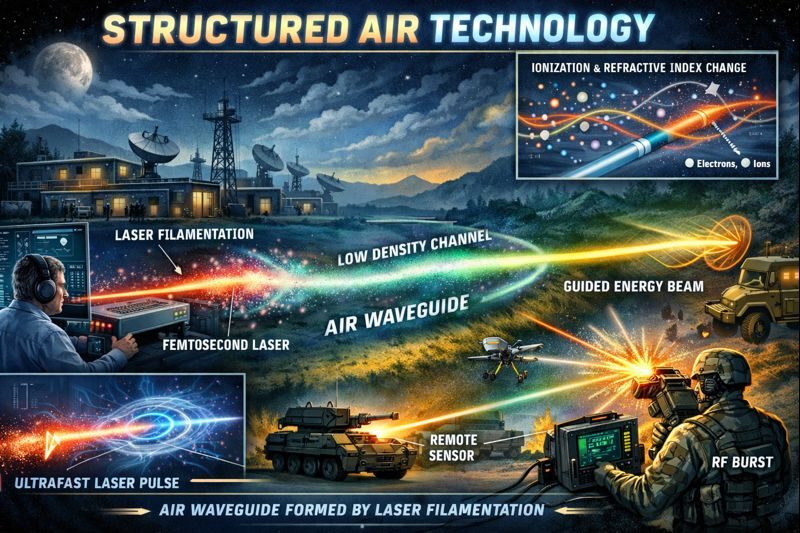
What you’re calling “structured air” isn’t a single standardized term in engineering or physics. In publicly available literature, it shows up as several different concepts that all share one idea: deliberately creating spatial structure in air (flow, density, refractive index, ionization/conductivity) so the air behaves like a component (a waveguide, lens, channel, insulator, etc.).
Below is what the term most commonly means, and then the most plausible Aberdeen, Maryland–area interpretation based on open publications tied to DEVCOM Army Research Laboratory (ARL) at Aberdeen Proving Ground. (DEVCOM Army Research Laboratory)
1) “Structured air” is used in at least three unrelated ways
A) Controlled airflow in commercial ovens (HVAC/foodservice meaning)
Some manufacturers use “Structured Air Technology” as a trademarked phrase for directed, high-velocity airflow patterns for more even heating and multi-zone control. (Alto-Shaam)
B) “Structured air” as a materials term (aerogels / porous “air packaged in a polymer”)
Blueshift Materials, for example, explicitly describes its thin polyimide aerogel products as “structured air” (very high air fraction with nanoscale pores), emphasizing thermal + RF/dielectric performance. (Blueshift Materials)
Composites industry coverage also uses “structured air” when describing these aerogel-based thermal protection systems. (CompositesWorld)
C) The “Aberdeen-relevant” meaning: air structured by high-power EM/optical fields
In defense / photonics contexts, what matches your description best is intentional structuring of the atmosphere (density, refractive index, and sometimes plasma/ionization) using ultrashort-pulse lasers—creating air waveguides or filament-formed channels that can guide light, enhance remote sensing, or couple to RF effects. (arXiv)
2) What the open literature ties to Aberdeen/APG: ultrashort-pulse laser filamentation → air waveguides
DEVCOM ARL has a major presence at Aberdeen Proving Ground. (DEVCOM Army Research Laboratory)
Open conference abstracts and papers with ARL/APG affiliations describe experiments where femtosecond laser filaments deposit energy into air, producing localized density depressions and long-lived refractive-index structures (“air waveguides”) that can guide a secondary beam over large distances (reported up to ~50 m in at least one line of work). (arXiv)
In other words, the “structured air” is literally the atmosphere being turned into a transient optical component.
3) How “structuring the air” works (technical mechanism)
This is the core physics behind the Aberdeen-linked “air waveguide / filamentation” work:
- Launch an ultrashort, high-peak-power laser pulse (typically femtoseconds).
- In air, nonlinear optics causes self-focusing (Kerr effect). As intensity rises, air starts to ionize and forms a plasma that counteracts collapse. The balance produces a filament: a narrow, extended region of high intensity and ionization. (This is the “filamentation” regime.)
- The filament deposits energy into the air, heating it.
- On microsecond-to-millisecond timescales, heating drives hydrodynamic expansion, leaving a lower-density channel (and therefore a modified refractive index profile). With the right geometry (often using multiple filaments or shaped beams), you can create a waveguide-like index structure in free air that persists long enough to guide another beam. (arXiv)
A commonly discussed design choice is beam shaping / multi-filament patterns (e.g., ring-like filament distributions) to form a “core + cladding” analog in air—i.e., not just a random heated column, but a designed refractive index structure. (arXiv)
4) Why microwaves/RF show up in the same conversations
Once you accept “air can be structured,” there are two broad RF-adjacent reasons this research intersects with defense programs:
A) Plasma/ionization channels can behave like RF structures (at least transiently)
A filament leaves ionization and can create conductive/semiconductive behavior for short times. That invites ideas like remote antenna-like effects, discharge guidance, or coupling to electromagnetic propagation under certain regimes.
B) There is explicit DoD-funded discussion of “remote RF generation” using laser channels
Open program/report language includes topics like “localized high power RF generation at large distances using self-channeled laser beams” and related ultrashort-pulse laser workshop activity. (CREOL)
A High Energy Laser Joint Technology Office (HEL-JTO) final report on filament interactions also discusses limitations and engineering realities of using filaments for RF-related effects (including the point that filaments are generally inefficient RF sources unless augmented by additional methods). (Survey Gizmo)
This is the cleanest “structured air + RF” link you can point to using open documentation.
5) “Company near Aberdeen” candidates visible in open author affiliations (contractor support around APG)
Public conference abstracts tied to ARL/APG list local/nearby contractor affiliations alongside ARL and university partners. For example:
- An Optica/CLEO abstract lists US Army Research Laboratory, Aberdeen Proving Ground and Bowhead Science and Technology (Belcamp, MD) as author affiliations. (Optica Publishing Group)
- Bowhead describes itself as providing engineering/scientific support to federal/DoD missions. (Bowhead)
- Another Optica abstract lists ARL/APG authors alongside a contractor (example: TKC Global appears as an affiliation in at least one ARL-linked abstract). (Optica Publishing Group)
Important distinction (factual): these sources show contractor presence supporting ARL work in relevant technical areas; they do not prove any specific contractor brands the work internally as “structured air.” What they do show is that the Aberdeen-area ecosystem (ARL + contractors + universities) is publishing on techniques that literally “structure air” via filamentation/waveguides. (arXiv)
6) How to narrow down the exact Aberdeen-area entity you mean (fastest open-source path)
If you’re trying to identify which Aberdeen-area group someone called “structured air,” the most effective search pivots are the technical terms used in the open literature:
- “air waveguide”
- “laser filamentation” / “femtosecond filament”
- “thermal waveguide”
- “self-channeled laser beams”
- “remote RF generation” + “filament”
- “ultrashort pulse laser” + “Aberdeen Proving Ground” (arXiv)
If you share any one of these (company name, program nickname, building number, a snippet from a slide, an email signature line, a contract vehicle name, etc.), the mapping to a specific Aberdeen-area contractor vs. ARL directorate usually becomes straightforward.
Endnotes (URLs)

[1] DEVCOM ARL – Aberdeen Proving Ground (location page)
https://arl.devcom.army.mil/who-we-are/locations/apg/

[2] arXiv preprint describing filament energy deposition creating long-lived air waveguides (~50 m guiding reported)
https://arxiv.org/abs/2208.04240

[3] Optica abstract page: “Optical Guiding in 50 Meter-Scale Air Waveguides” (includes ARL/APG affiliations)
https://opg.optica.org/abstract.cfm?uri=FIO-2022-FTh4D.4

[4] UCF annual report page containing DoD-linked items including “localized high power RF generation … using self-channeled laser beams” and “multi-structured air filamentation …”
https://stars.library.ucf.edu/annualreports/7/

[5] HEL-JTO report: “Fundamentals of Filament Interaction” (discussion of filament interactions + RF-related constraints)
https://apps.dtic.mil/sti/pdfs/ADA623054.pdf

[6] Optica abstract showing ARL/APG + Bowhead Science and Technology (Belcamp, MD) affiliations
https://opg.optica.org/abstract.cfm?uri=CLEO_QELS-2014-JTh2A.84

[7] Bowhead Science and Technology (company page)
Bowhead Science and Technology

[8] Blueshift Materials: “We often describe AeroZero as structured air …” (materials meaning)
Blueshift Materials’ AeroZero® Targets the Surging High-Frequency High-Speed Materials Market

[9] Alto-Shaam “Structured Air Technology®” (airflow/oven meaning)
https://www.alto-shaam.com/en/technology/structured-air-technology