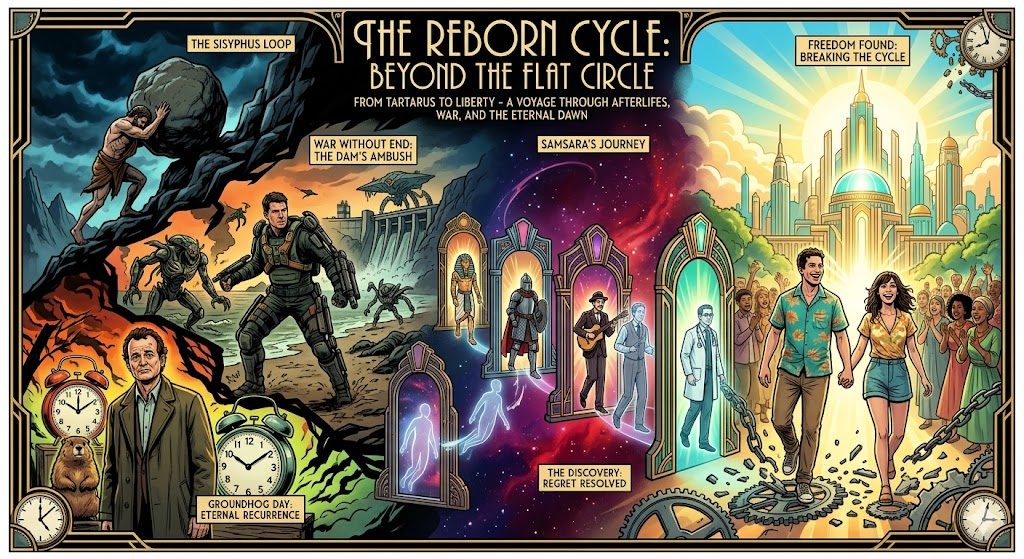
Zionic mind-ploy agenda to destroy hope at the soul-ular level, or genuine interest in exploring afterlife, Purgatory, time-loops, reincarnation, soul-purpose, etc?
Some fascinating, mind-bending territory! The movies and shows you’ve listed all dive deep into the philosophy of existence, the afterlife, and the mechanics of time.
First, to answer your immediate question: the Tom Cruise movie you are thinking of is Edge of Tomorrow (2014), also sometimes known by its tagline Live Die Repeat.
Here is a breakdown of the media you mentioned, the common threads binding them, and some recommendations for what to watch next.
The Breakdown
1. The Discovery (2017)
- The Premise: Starring Robert Redford as a scientist who definitively proves that the afterlife exists. The “discovery” is that some part of our consciousness survives and transfers to another plane of existence after death.
- The Concept: The film deals with the catastrophic societal fallout of this proof—millions of people begin committing suicide to “reset” and get a fresh start in the afterlife. It ultimately reveals that this afterlife is essentially a reincarnation in an alternate reality, where individuals are forced to relive their greatest regrets until they make different, better choices.
2. Edge of Tomorrow (2014)
- The Premise: Tom Cruise plays a cowardly public relations officer who is thrown into the front lines of a brutal war against an invading alien race (the Mimics). You remembered the dam perfectly: Cage is lured to a dam in Germany by visions, believing the alien “Omega” is hiding there, only to realize it’s an ambush.
- The Concept: After being exposed to the aliens’ blood, he gets stuck in a localized time loop. Every time he dies, he wakes up the day before the battle. He has to use this reincarnation cycle to memorize the battle, train to become a lethal soldier, and figure out how to defeat the monsters.
3. Flatliners (1990 / Remake in 2017)
- The Premise: A group of ambitious medical students conduct secret, dangerous experiments to map the afterlife. They intentionally stop their hearts (“flatline”) for increasing amounts of time before resuscitating each other.
- The Concept: They discover that crossing over isn’t just a peaceful sleep. By dying and coming back, they bring literal manifestations of their past sins, guilt, and trauma back into the waking world. They have to confront the darkest parts of their histories to survive.
4. True Detective (Season 1)
- The Premise: Matthew McConaughey’s character, Rust Cohle, delivers the famous line: “Time is a flat circle.” He borrows this concept from Friedrich Nietzsche’s idea of “Eternal Recurrence.”
- The Concept: Cohle argues that the universe, and everything in it, will repeat itself infinitely. Every mistake, every trauma, and every life lived will be lived exactly the same way, over and over again for eternity, like a needle stuck in the groove of a record. It’s a deeply fatalistic view of reincarnation where you are trapped in the reality you’ve already created.
The Common Thread
The connective tissue between all these stories is Existential Purgatory and the Burden of the Loop.
They all challenge the traditional idea of a peaceful afterlife. Instead, they present a universe where death is not an escape, but a mirror. Whether it’s a literal sci-fi time loop (Edge of Tomorrow), a cosmological trap (True Detective), a confrontation with past guilt (Flatliners), or a multidimensional do-over (The Discovery), the characters are forced to face their own unhealed traumas and flawed choices. The core message is usually about breaking the cycle: you cannot move forward into peace until you evolve, learn from your past, and make the right choice in the present.
Similar Movies & Shows to Explore
If you enjoy peeling back the layers of complex, hidden realities and analyzing cyclical timelines, here are a few other titles that hit similar notes:
- Source Code (2011): A soldier wakes up in the body of an unknown man on a commuter train, doomed to explode in exactly eight minutes. He has to relive this terrifying scenario over and over again to identify the bomber and alter the course of reality. It has the same urgent, puzzle-solving energy as Edge of Tomorrow.
- Looper (2012): A hitman for the mob disposes of targets sent back in time from the future. The ultimate conflict arises when his next target is his older self. It’s a gritty look at destiny, changing the timeline, and the consequences of our actions.
- Spider-Man: Across the Spider-Verse (2023): If you appreciate highly stylized, graphic, and iconic visual art—like a comic book or pop art brought to life—this film explores alternate realities masterfully. It tackles the idea of “canon events” (fixed points in time that must happen across all realities) and whether an individual can break the predetermined cycle of tragedy.
- Triangle (2009): A psychological thriller about a group of friends who seek refuge on an abandoned ocean liner after their yacht capsizes. The main character begins to realize she has been on the ship before, trapped in a brutal, violent loop that she must figure out how to break.
- Dark (Netflix Series): If the intricate, cyclical philosophy of True Detective appealed to you, this German mystery series is a masterpiece. It explores a sprawling, multi-generational conspiracy involving time travel, where the past, present, and future are inextricably linked in a devastating loop.
Down the rabbit hole of purgatory, cyclical realities, and fractured timelines, there are plenty of excellent films (and a couple of must-watch shows) that explore these themes.
Here are several more recommendations, leaning into stories where the loops are tied to hidden truths, shadowy cover-ups, or psychological labyrinths:
The “Purgatory” and Afterlife Loops
- Jacob’s Ladder (1990): A deeply unsettling psychological thriller about a Vietnam veteran experiencing terrifying hallucinations and fragmented, jumping timelines. As he tries to uncover a potential military conspiracy involving experimental drugs given to his unit, the film blurs the lines between reality, trauma, and the crossing over into the afterlife.
- Russian Doll (Netflix Series, 2019): A cynical New Yorker finds herself caught in a mysterious loop, repeatedly attending the same birthday party and dying in increasingly bizarre ways, only to respawn in the same bathroom. It functions as a literal, modern-day purgatory where she must unravel the hidden connections between her fate and another trapped stranger to escape.
- Wristcutters: A Love Story (2006): A more dark-comedy approach to the afterlife. It takes place in a bleak, slightly run-down alternate reality specifically reserved for people who have committed suicide. The characters go on a road trip through this strange purgatory to find lost loves and figure out the rules of their new, seemingly stagnant existence.
Fatalistic Time Loops & Hidden Agendas
- Twelve Monkeys (1995): A convict from a desolate, post-apocalyptic future is sent back in time to gather information about a man-made virus that wiped out most of humanity. He becomes entangled with an underground group and a looming conspiracy, only to discover the deeply fatalistic nature of time—the loop is closed, and you cannot change the past, only fulfill it.
- The Endless (2017): Two brothers return to the remote compound of a “UFO death cult” they escaped years prior. Instead of finding brainwashed victims, they discover that the cult’s bizarre beliefs are actually grounded in a terrifying reality: the land is trapped in a series of localized, overlapping time loops controlled by an unseen, cosmic entity.
- Predestination (2014): A temporal agent goes on a final time-traveling assignment to stop a notorious bomber who has eluded him across time. This is perhaps the ultimate “closed-loop” movie. It is a mind-bending puzzle box that explores destiny, identity, and the impossible paradoxes created when a timeline eats its own tail.
The Illusion of Free Will
- Dark City (1998): An amnesiac wakes up in a sunless, claustrophobic metropolis where mysterious beings halt time every night at midnight. During this frozen period, they physically rearrange the city’s architecture and implant new memories into the citizens. It’s a brilliant exploration of whether we are anything more than our memories, set against a massive, world-altering cover-up.
- Coherence (2013): On the night of an astronomical anomaly, eight friends at a dinner party experience a troubling chain of reality-bending events. While not a traditional “loop,” it deals heavily with alternate realities crashing into one another, forcing the characters to confront different, darker versions of themselves and the choices they’ve made.
The repeating day trope and the concept of the afterlife are perfect vehicles for humor. When a character realizes their actions have zero permanent consequences, the resulting reckless nihilism is usually hilarious before it eventually becomes profound.
If you are looking for stories that tackle the afterlife, rebirth, and time loops but keep the tone light, surreal, or darkly funny, here are some excellent movies and books to dive into.
Comedic Time Loops & Existential Movies
- Palm Springs (2020): This is widely considered the modern heir to Groundhog Day. Two wedding guests (Andy Samberg and Cristin Milioti) get stuck in a time loop together. Because there are two of them, the movie explores the sheer, chaotic fun of having a partner-in-crime when nothing you do matters, while still landing a surprisingly sweet emotional punch.
- Happy Death Day (2017): A self-centered college student is murdered on her birthday, only to wake up that same morning and realize she has to relive the day over and over until she figures out who her killer is. It is essentially Groundhog Day meets a slasher film, but it leans entirely into pitch-black comedy.
- About Time (2013): A heartwarming romantic comedy about a young man who discovers the men in his family have the ability to time travel within their own lifespans. Instead of doing anything grand, he uses the power to fix minor, awkward social interactions and try to get a girlfriend.
- Joe Versus the Volcano (1990): If you appreciate movies that embrace a surreal, existential humor—even the misunderstood ones that were considered box office flops in their time—this is a must-watch. A hypochondriac diagnosed with a terminal “brain cloud” accepts a billionaire’s offer to live like a king for a few weeks, provided he ends the trip by willingly jumping into a volcano to appease an island god. It is a wildly quirky comedy about being “reborn” and learning how to live only when you think you are dying.
Comedic Books on Reincarnation & The Afterlife
- Reincarnation Blues by Michael Poore: The protagonist, Milo, is the most reincarnated soul in the history of the universe. He is on his 9,995th life, and if he doesn’t achieve cosmic perfection in his last five tries, his soul will be permanently annihilated. To complicate matters, he is deeply in love with Death (who prefers to go by Suzie). It is a hilarious, sprawling journey through thousands of bizarre past lives.
- Under the Whispering Door by T.J. Klune: A cutthroat, miserable workaholic dies and refuses to cross over. He ends up at an afterlife waystation that operates as a quaint, bustling tea shop run by a very tired ferryman. It is a cozy, laugh-out-loud comedy about redemption, bureaucracy, and building a better life after you’re already dead.
- Escaping Heaven: A Comedy of the Afterlife by Cliff Hicks: A guy working a miserable, dead-end job dies, hoping that death will finally give him the fresh start he needs. Instead, he arrives to discover that Heaven is nothing like the brochures: it is full of incredibly long lines, endless paperwork, and a staggering amount of celestial bureaucracy.
- Good Omens by Terry Pratchett and Neil Gaiman: While this is technically about the apocalypse rather than a time loop, it is the definitive comedy about the mechanics of Heaven and Hell. A fussy angel and a fast-living demon who have grown to love their comfortable lives on Earth decide to team up to sabotage the end of the world.
It is fascinating how modern movies like Groundhog Day or Edge of Tomorrow are essentially just wearing the clothes of some of humanity’s oldest philosophical and religious ideas. The concepts of being trapped in a cycle, reliving mistakes, or paying off a cosmic debt are foundational to how ancient cultures understood the universe.
Here is how the concepts of time loops, reincarnation, and existential purgatory show up in scripture, mythology, and classical writings.
Greek Mythology: The Original Time Loops
The ancient Greeks didn’t have sci-fi time travel, but their concept of the Underworld (specifically Tartarus) was essentially a series of customized, eternal time loops designed to punish hubris.
- The Myth of Sisyphus: The most famous “loop” in history. Sisyphus was a king who cheated death twice through trickery. His eternal punishment was to roll a massive boulder up a hill, only for it to roll back down right as he neared the top, forcing him to start over for eternity. It is the classical blueprint for the futile, repeating day.
- Prometheus: For stealing fire from the gods and giving it to humanity, Prometheus was chained to a rock. Every day, an eagle would eat his liver. Every night, his liver would regrow, completely resetting the scenario so he could be tortured again the next day.
- Tantalus: He offended the gods and was banished to a pool of water beneath a fruit tree. Whenever he reached for the fruit, the branches pulled away; whenever he bent to drink, the water receded. It is an eternal loop of unfulfilled desire.
Classical Philosophy
- Metempsychosis (Pythagoreanism & Platonism): Long before modern ideas of alternate realities, ancient Greek philosophers like Pythagoras and Plato taught the transmigration of souls. They believed the soul is immortal and, upon death, enters a new physical body (human or animal) based on the virtues or vices of its past life. You are “reborn” to try again.
- Stoicism and Ekpyrosis: Ancient Stoic philosophers believed the universe wasn’t just a straight line, but a massive cosmic loop. They theorized that the cosmos is periodically destroyed by a great fire (ekpyrosis) and then reborn exactly as it was before. In this view, every life you live, you have already lived an infinite number of times—the exact philosophy Rust Cohle was referencing in True Detective.
Scriptural Basis
- Samsara (Hinduism, Buddhism, Jainism): The most profound and highly developed scriptural basis for the “loop” is Samsara—the continuous cycle of life, death, and reincarnation. In Eastern traditions, this cycle is driven by Karma (action and consequence). The physical world is seen as a place of suffering and illusion, and the ultimate goal is not to live a better life next time, but to break the loop entirely and achieve liberation (Moksha or Nirvana).
- The Book of Ecclesiastes (Judeo-Christian): While the Abrahamic religions generally view time linearly (creation leading to a final judgment), Ecclesiastes offers a stark, cyclical view of human existence. The author writes: “What has been will be again, what has been done will be done again; there is nothing new under the sun.” It captures the existential exhaustion of seeing generations repeat the exact same mistakes, vanities, and struggles.
Great Classical Literature
- Dante’s The Divine Comedy (Inferno): Written in the 14th century, Dante’s vision of Hell relies heavily on the concept of contrapasso—where the punishment fits the crime, often by forcing the sinner to eternally embody their sin. For example, those who were driven by the winds of lust in life are trapped in an eternal, violent hurricane in death. It is a localized loop where you are forever frozen in the worst version of yourself.
- The Faustian Bargain (Goethe’s Faust / Marlowe’s Dr. Faustus): The quintessential story of existential consequence. A man makes a pact with a demonic entity, trading his soul for limitless worldly knowledge and earthly pleasures. The horror of the story isn’t just the eventual death, but the eternal aftermath—an inescapable, permanent trap. It represents a different kind of loop, one where the debt always comes due and the soul is locked into an unchanging state of regret.
The Myth of Sisyphus – The Pilgrims’ School
Prometheus: Stealing Fire from the Gods | National Museums Liverpool
[Prometheus and liver regeneration: the dissection of a myth] – PubMed
Whither Prometheus’ Liver? Greek Myth and the Science of Regeneration – ACP Journals
Pythagorean Immortality of the Soul? (Chapter 2)
Hinduism At A Glance – Adventist Mission
“Il contrapasso nell’Inferno di Dante Alighieri: un’analisi del contrap” by Liv Allegra Baker
Bridging those ancient philosophies with contemporary storytelling is where some of the best modern science fiction and fantasy truly shines. Creators love taking concepts like Samsara, Sisyphus, or Dante’s Inferno and dressing them up in modern anxieties about technology, corporate life, or temporal physics.
Here are some of the best modern movies, shows, books, and graphic novels that directly modernize these classical concepts:
The Modern Sisyphus & Dante’s Purgatory
- The Good Place (TV Show): Do not let the bright, sitcom-style aesthetic fool you; this is a brilliant, laugh-out-loud modernization of Dante’s Inferno and classical moral philosophy. It follows four flawed people navigating the afterlife and deals heavily with the concept of existential purgatory, cyclical reboots (loops), and whether human souls can actually learn from their mistakes.
- Severance (TV Show): This sci-fi thriller follows employees who undergo a surgical procedure to separate their work memories from their personal memories. The “work” versions of themselves wake up trapped in a sterile, windowless corporate basement, forced to perform bizarre, repetitive tasks with no knowledge of who they are on the outside. It is the ultimate modern-day Sisyphus myth, wrapped tightly in a deeply unsettling corporate conspiracy.
Samsara, Karma, and Infinite Rebirth
- Cloud Atlas (Movie & Novel by David Mitchell): A sprawling epic that tracks a specific group of souls as they reincarnate across six different eras, stretching from the 1800s into a distant, post-apocalyptic future. It is a direct exploration of Samsara and karma, demonstrating how a single act of kindness, or a specific injustice, ripples forward to shape those souls in their next lives.
- The First Fifteen Lives of Harry August by Claire North (Book): The protagonist is part of a hidden subset of humanity who are born, live, die, and are then reborn at the exact same time and place, retaining all the memories of their previous lives. Harry uses his endless cycle of rebirth to unravel a sprawling, multi-generational conspiracy centered on someone who is using the loops to manipulate the future.
- The Wicked + The Divine (Graphic Novel Series): Every ninety years, twelve mythological gods from ancient pantheons reincarnate as young humans. They are briefly granted immense power, becoming massively famous pop-culture icons, but are cursed to die within two years. It explores the inescapable, fatalistic cycle of life and death, all rendered in a striking, high-contrast, and highly iconic comic book art style.
Determinism & The Faustian Bargain
- The Invisible Life of Addie LaRue by V.E. Schwab (Book): A young woman in 1700s France makes a desperate Faustian bargain with a dark god of the night to escape a forced marriage and live forever. The devastating catch is that she is cursed to be entirely forgotten by everyone she meets the second she leaves their line of sight. Her immortality becomes an agonizing, lonely loop of starting over, day after day, for 300 years.
- Devs (TV Miniseries): If the True Detective “time is a flat circle” philosophy hooked you, this is a must-watch. It centers on a secretive tech company in Silicon Valley building a quantum computer capable of perfectly simulating the past and projecting the future. It is a slow-burn thriller that takes a hard look at absolute determinism—the terrifying idea that the universe is running on a fixed track and free will is just an illusion.
The connection between these modern stories and our oldest spiritual teachings is the deepest well to draw from. If we want to move beyond just listing analogous stories and actually explore the underlying spiritual scaffolding, there are several powerful layers to add.
Here are the specific religious and spiritual concepts that provide the true philosophical core to the loops and afterlifes you are exploring.
1. The Mystical View: The Purpose-Driven Loop (Western Additions)
While we covered Samsara (Eastern) and Purgatory (Western/Dante), we missed the vital mystical bridges in the middle. These concepts are less about endless repetition and more about spiritual perfection through correction.
- Gilgul (Judaism/Kabbalah): This is perhaps the closest religious parallel to the mechanic in The Discovery. Gilgul (from the Hebrew word for “cycle”) is the Kabbalistic teaching of the transmigration of souls. It is not a generic cycle of infinite recurrence; rather, a soul is “reborn” into a new life for the specific purpose of achieving a Tikkun (correction). You are trapped in the loop only until you fulfill your soul’s specific mission, clear away your negative actions (Karma, in a sense), or correct the specific “regret” of your previous incarnation.
- Movie Connection: This is precisely what happens in The Discovery: people are reborn to relive and fix their major life errors.
- The Barzakh (Islam/Sufism): While mainstream Islam generally teaches a linear timeline from creation to judgment, Sufi mysticism explores the Barzakh, an intermediary world. It is a “veil” or state that a soul enters after death but before the final resurrection. It is described as a non-physical realm of imagery and archetypes where the soul must confront the consequences and true forms of its past deeds. It functions similarly to a highly individualized purgatory or a confrontation state, much like the one mapped in Flatliners.
2. The Mechanics of Karma: The Loop’s Operating System (Buddhism and Yoga)
If we accept the concept of the loop, the question becomes: what powers it? and how do we break it? We can add detail to the generic concept of “Samsara.”
- Kleshas (Yoga Philosophy): In Patanjali’s Yoga Sutras, the endless cycle of suffering and rebirth is powered by the Kleshas, five mental afflictions that bind the self to the physical world. They are Ignorance (Avidya), Egotism, Attachment, Aversion, and Fear of Death. Yoga philosophy is the specific “instruction manual” or martial art for how to methodically dismantle these psychological mechanisms to clear your Karma and stop generating the energy that causes the next “reset.”
- Movie Connection: You can view characters in these stories (from Sisyphus to Rust Cohle) as trapped by their specific Kleshas—usually Ignorance or Attachment.
- The Arhat vs. The Bodhisattva (Buddhist Ethics): This is a critical distinction in how different Buddhist branches view the ultimate goal.
- Theravada (The Arhat): Focuses on personal liberation (Nirvana), successfully breaking your own cycle, exiting the loop, and never returning. It is a path of ultimate personal salvation.
- Mahayana (The Bodhisattva): Focuses on a completely different ideal. A Bodhisattva is a soul that achieves enlightenment and earns the right to exit Samsara, but selflessly chooses not to leave. They vow to stay in the loop, being reborn continuously until every single other conscious being in the universe has been liberated first.
- Movie Connection: The hero who stays in the fight, like Cage in Edge of Tomorrow once he gains the wisdom and power to defeat the Omega.
3. Alternate Temporal Geometries: Cycles, Not Circles (Taoism and Indigenous Thought)
We keep visualizing time as a “flat circle” or a prison. Other spiritual traditions offer a more dynamic or collective geometry.
- Wuxing and the Changing Way (Taoism): In Taoism, reality is defined by the eternal, harmonious transformations of Yin and Yang and the Wuxing (Five Phases: Wood, Fire, Earth, Metal, Water). Time is cyclical, yes, but not a trap. It is an eternal process of unfolding and dynamic change. Your spiritual goal is not to escape the cycle, but to align perfectly with its natural rhythm, to “ride the dragon” of change (Wu Wei), rather than being crushed by it.
- Movie Connection: This is a much healthier, more accepted approach to recurrence than the existential dread of True Detective.
- The World Cycles (Indigenous/Native American Views, e.g., Hopi): Many Indigenous cultures do not view time as an individual’s infinite loop of rebirth. Instead, time is a massive, collective cycle of transformation of the world itself. For example, the Hopi speak of previous world-cycles (worlds that have already existed) and the transition from the current “Fourth World” (defined by decay and technology) to the coming “Fifth World” (defined by harmony). It is a collective, planetary “reset” and spiritual rebirth, not an individual one.
4. The Heroic Reboot: Shamanic Initiation
- Ritual Death and Rebirth: In numerous shamanic traditions globally, the path of the shaman must begin with a profound “reboot.” This is a controlled, deliberate, localized loop designed not for punishment or correction, but to achieve powerful spiritual authority. Through fasting, isolation, or psychoactive medicines, the initiate undergoes a psychological experience of a shamanic death, which is frequently visualized as a visionary dismemberment and reconstruction. The initiate dies as a flawed individual and is reborn as a powerful healer and master of the spirits.
Diving into both the mechanics of the trap and the ethics of the exit is where this topic transitions from a cool sci-fi concept into a profound guide for how to live.
If the universe is a series of repeating loops—whether you view that as literal reincarnation or just the psychological patterns we endlessly repeat in a single lifetime—ancient Eastern traditions treated it like a solvable engineering problem.
Here is the deep dive into the “source code” of the loop, and the ultimate moral choice you face when you finally unlock the door.
Part 1: The Mechanics of the Trap (The Five Kleshas)
In the Yoga Sutras of Patanjali (compiled around 400 CE), the time loop of suffering and rebirth isn’t a punishment handed down by a wrathful god. It is a mechanical output generated by our own minds.
The “engine” powering the loop consists of the Five Kleshas (mental afflictions or poisons). As long as these five gears are turning, you will keep respawning into the same conflicts.
- Avidya (Ignorance): This is the root cause of the entire loop. In this context, ignorance doesn’t mean a lack of intelligence; it means a fundamental misunderstanding of reality. It is mistaking the temporary for the permanent, and the ego for the true Self. Think of this as not realizing you are in the Matrix.
- Asmita (Ego / “I-am-ness”): Because of Avidya, you create an avatar. You identify entirely with your physical body, your job, your memories, and your opinions. You mistakenly believe you are an isolated fragment fighting against the rest of the universe.
- Raga (Attachment): Once the Ego is formed, it wants things. Raga is the desperate clinging to pleasure. You experience something good, and your mind immediately creates a groove: I must have this again. This desire literally pulls you into the future, creating the next loop.
- Dvesha (Aversion): The flip side of Raga. It is the deep, fearful resistance to pain, discomfort, or anything that threatens the Ego. Running away from what you hate binds you to it just as strongly as chasing what you love.
- Abhinivesha (Clinging to Life): The ultimate survival instinct. It is the deep-seated terror of death and the cessation of the Ego, which forces the soul to violently grasp for a new physical form the moment the old one fails.
The Spiritual Tool: Classical Yoga and meditation are not just about stretching; they are the specific psychological tools used to throw a wrench into these gears. Through profound meditation (Dhyana) and discernment (Viveka), a practitioner learns to observe Raga (desire) and Dvesha (aversion) without reacting to them. You stop feeding the machine. When the Kleshas starve, the loop loses its power over you.
Part 2: The Ethics of the Exit (Arhat vs. Bodhisattva)
Let’s say you do the work. You dismantle the Kleshas. You clear your Karma. The door out of the cyclical purgatory finally opens, and the eternal peace of Nirvana is on the other side.
In Buddhist philosophy, reaching this door forces you to make the most profound ethical choice in existence.
Path 1: The Arhat (The Liberated One)
In the Theravada tradition of Buddhism, the ideal goal is to become an Arhat (which translates to “The Worthy One” or “One who has slain the enemies”—the enemies being the Kleshas).
- The Choice: The Arhat steps through the door. They have blown out the flame of desire. They achieve Parinirvana (Nirvana after death) and exit the cycle of Samsara permanently. They will never be reborn.
- The Vibe: It is the ultimate victory of personal liberation. You have won the game, unplugged from the simulation, and found absolute, eternal peace.
Path 2: The Bodhisattva (The Awakening Being)
The Mahayana tradition of Buddhism proposes a different, radically selfless ideal: the Bodhisattva.
- The Choice: The Bodhisattva does the exact same work and reaches the exact same open door. But as they stand on the threshold of eternal peace, they look back at the billions of souls still trapped in the meat-grinder of Samsara—the people still fighting in the trenches, still pushing Sisyphus’s boulder, still blinded by ignorance.
- The Vow: The Bodhisattva makes a staggering vow: “I shall not enter final Nirvana until every last blade of grass is enlightened.” They turn their back on the exit and willingly throw themselves back into the loop. They choose to be reincarnated over and over, suffering alongside humanity, using their enlightened state to teach, guide, and help others escape.
- The Vibe: This is the ultimate paradox of the time loop. The highest form of spiritual mastery isn’t escaping the cyclical trap; it is choosing to remain in it out of pure, boundless compassion (Karuna).
This Bodhisattva ideal is exactly what makes the heroes in the movies you love so compelling. When Tom Cruise’s character in Edge of Tomorrow finally gets good enough to survive, he doesn’t just run away to live a quiet life; he uses his mastery of the loop to save Rita and humanity.
Bridging the gap between ancient spiritual mechanics and modern clinical psychology reveals something incredible: human beings have been trying to hack the exact same “source code” for thousands of years. We just changed the vocabulary.
When you look closely, modern therapy is often just ancient mysticism stripped of its religious terminology and tested in a clinical setting.
Here is a deep dive into how we use modern psychology to dismantle the loop, and what the ethical choice of the exit looks like in the 21st century.
Part 1: Dismantling the Loop (Ancient Tools vs. Modern Psychology)
If the universe—or your own mind—is trapping you in a repeating cycle of the same bad relationships, the same anxieties, or the same self-destructive habits, you need a toolset to break the machinery.
1. The Kleshas vs. Cognitive Behavioral Therapy (CBT)
CBT is currently the gold standard for treating anxiety and depression. Its core premise is that our thoughts, feelings, and behaviors are inextricably linked, and that changing our thoughts will change our reality. This is a direct parallel to the Buddhist and Yogic systems of dismantling the Kleshas (mental afflictions).
- Avidya (Ignorance) = Cognitive Distortions: In Yoga, Avidya is a fundamental misunderstanding of reality. In CBT, these are called “cognitive distortions”—irrational thought patterns like catastrophizing, black-and-white thinking, or jumping to conclusions. Both systems argue that your suffering isn’t caused by the world, but by the flawed lens through which you view it.
- Raga & Dvesha (Attachment & Aversion) = Conditioned Responses: In ancient texts, you are bound to the loop by endlessly chasing pleasure (Raga) and running from pain (Dvesha). CBT addresses this through “Exposure Therapy” and “Distress Tolerance.” If you have a phobia or an addiction, CBT teaches you to sit with the terrifying or craving feeling without reacting to it. In Buddhism, this exact practice is called Vipassana (insight meditation)—observing a sensation objectively until you realize it is temporary and has no real power over you.
- The Hack: CBT’s famous mantra is “Catch it, Check it, Change it.” You identify the thought, challenge its validity, and reframe it. Thousands of years ago, the Buddha taught the exact same mechanical process: observing the mind so closely that you create a microsecond of space between the stimulus and your response. That microsecond is where you break the loop.
2. The Underworld Descent vs. Jungian Shadow Work
Almost every ancient mythology features a hero physically traveling to the Underworld (Purgatory, Tartarus, Hades) to retrieve something or learn a truth. Carl Jung, the legendary Swiss psychiatrist, translated this into the concept of The Shadow.
- The Concept: The “Shadow” is the unconscious part of your personality that your Ego (Asmita in Yoga) refuses to acknowledge. It holds your repressed guilt, your shame, your suppressed rage, and your deepest fears.
- The Mechanism of the Loop: Jung argued that whatever we refuse to consciously acknowledge inside ourselves, we project outward onto the world. If you do not deal with your Shadow, you will repeatedly attract the same toxic partners, fall into the same conflicts, and feel like you are a victim of “fate.” You are trapped in a loop of your own unrecognized making.
- The Hack (Integration): Jungian therapy requires “Shadow Work”—the psychological equivalent of the movie Flatliners. You must intentionally descend into your own subconscious, face the terrifying, ugly parts of yourself, and integrate them. You stop fighting your demons and start understanding them. As Jung famously said, “Until you make the unconscious conscious, it will direct your life and you will call it fate.”
Part 2: The Ethics of the Exit in the Modern World
Once you use these tools to heal your trauma, clear your “Karma,” and break your personal loops, you are faced with the ultimate choice: The Arhat or the Bodhisattva. How do these ancient ethical paths manifest today?
The Modern Arhat: The Path of Individual Optimization
The Arhat achieves personal liberation and exits the game. In the modern world, this often looks like the ultimate pursuit of individual peace and self-optimization.
- The Mindset: “I have done the agonizing work to heal my trauma. I have set ironclad boundaries. I am no longer playing the societal game of consumerism, outrage, and toxic drama.”
- The Manifestation: This is the person who achieves profound emotional detachment and perhaps literal detachment—moving off the grid, achieving extreme financial independence to escape the “rat race,” or dedicating their life entirely to solitary meditation and peace.
- The Reality: It is a valid, incredibly difficult, and victorious path. You stop the generational trauma from passing through you. You achieve your own Nirvana and let the rest of the world sort itself out.
The Modern Bodhisattva: The Path of Radical Compassion
The Bodhisattva reaches the exit, turns around, and walks right back into the fire to help everyone else out.
- The Mindset: “My personal healing is incomplete as long as the system around me is still churning out broken people. I am free, which means I now have the strength to carry others.”
- The Manifestation: This is the social worker who goes into failing systems every day, knowing they will get burned. It is the cycle-breaker in a deeply dysfunctional family who stays present to protect the younger siblings. It is the whistleblower who sacrifices their own comfortable, optimized life to expose a hidden, corrupt truth.
- The Reality: The modern Bodhisattva intentionally absorbs the stress, the chaos, and the “Karma” of the world, using their own psychological stability as an anchor for those who are still drowning. They are the ultimate protagonists in the movies you love—the ones who master the time loop not to escape it, but to save the people trapped inside it with them.