Politicized Weather Warfare- “…in other words, scandal ignition, federal cover-up behavior, and a regional water disaster all stacked into the same week.” Given the Jesuits’ predilection for mockery, ‘name games’ and “coinciDUNCE”… Maryland emergency management now describes Agnes as the deadliest named storm in Maryland history. Older tallies vary, but the key point is that Maryland remembers Agnes as a benchmark disaster, not a side story. 1972 sits at the exact intersection of active government weather-modification history, fresh legal structures for reporting such activity, and a major East Coast storm that overlapped the opening week of Watergate. That makes the concurrence field unusually dense even before any stronger theory is added
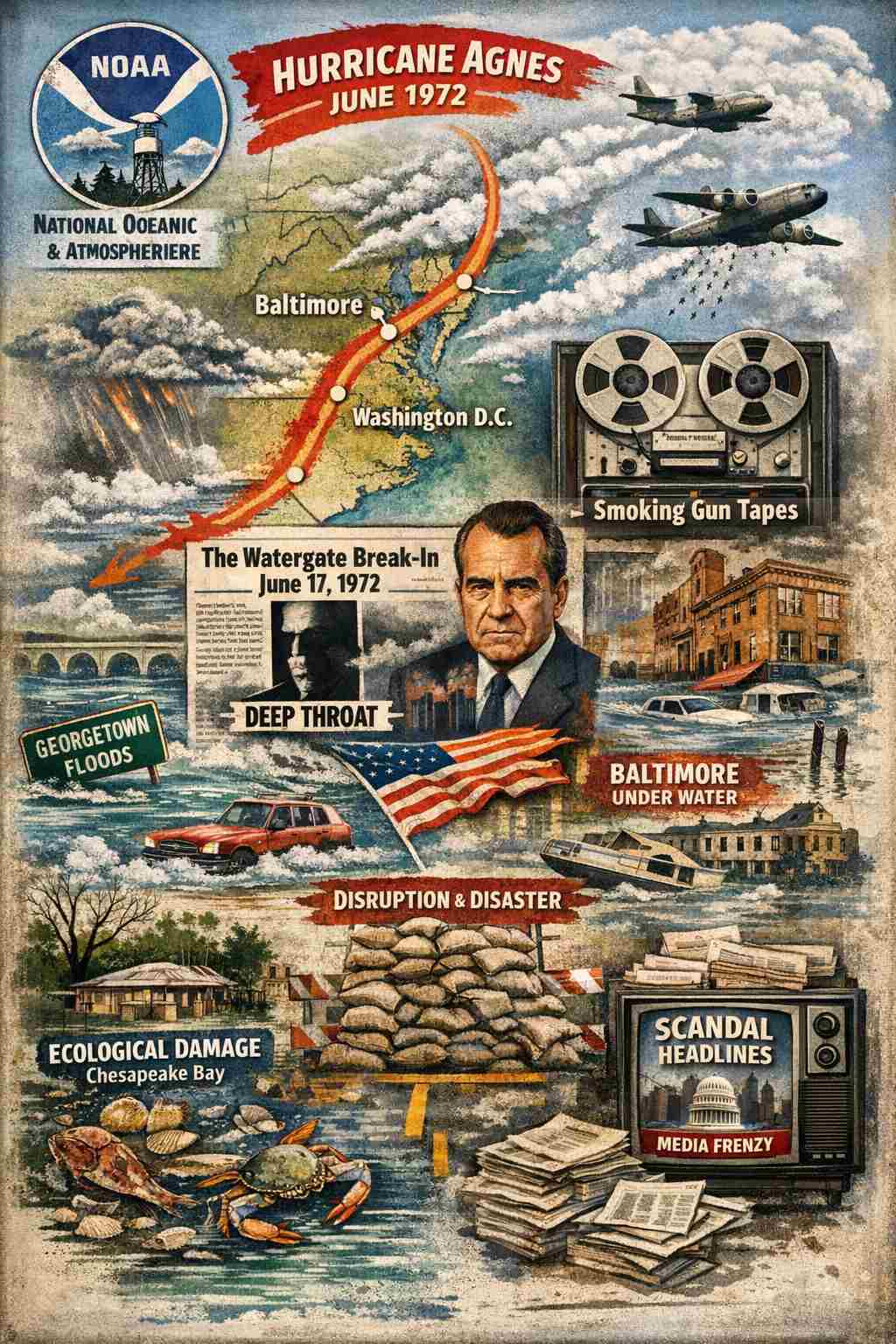
Odd time compression of events: the Watergate break-in was June 17, 1972; Woodward’s first meeting with “Deep Throat” was June 20; the June 23 Nixon-Haldeman “Smoking Gun” conversation happened as Agnes was flooding the Mid-Atlantic; and the Potomac peaked at Georgetown on June 24. In other words, scandal ignition, federal cover-up behavior, and a regional water disaster all stacked into the same week. (National Archives)
I’d break the concurrences into three bands: hard overlap, regional/tangential aftereffects, and weather-modification/legality context.
Hard overlap map
- The Watergate burglary and Agnes’s northward turn were effectively simultaneous events in the same national news cycle: June 17 for the burglary, June 19 for Agnes’s Florida landfall, and June 21–24 for the flood crisis in the D.C.–Maryland orbit. (National Archives)
- The first Woodward–Felt contact came June 20, just as Agnes was moving toward its most destructive Mid-Atlantic phase. That means the first quiet phase of the scandal grew under the cover of an oncoming regional emergency. (HISTORY)
- The June 23 “Smoking Gun” conversation happened the same day NOAA’s administrator designated a formal disaster survey team for Agnes. One branch of the federal state was beginning a disaster-assessment process while another branch was already moving into obstruction mode over Watergate. (Nixon Library)
- Washington-area flood impacts peaked basically one day after that June 23 tape: the Potomac hit flood crest in D.C. at Georgetown’s Key Bridge on June 24. (Washingtonian)
- A nice split-screen detail: one retrospective notes that Washingtonians were already distracted by the Watergate arrests as Agnes approached. That strongly suggests the two events competed for attention before Agnes fully declared itself. (Washingtonian)
- If you are looking for “disruption of legality,” this is a good one: the same week that lawbreaking at the Watergate complex became visible, emergency declarations and disaster administration were also ramping up across the same federal corridor. Baltimore City’s disaster history still lists Tropical Storm Agnes as a formal June 23, 1972 disaster declaration event. (City of Baltimore)
Baltimore / Maryland / D.C. concurrence field
- Agnes was not just “some East Coast storm.” In the Baltimore-Washington area it was a defining flood episode from June 21 to June 23, with record river responses in the region. (National Weather Service)
- The Patapsco reached record levels and caused major damage to Ellicott City’s business district. That places one of Maryland’s iconic flood disasters in the same immediate moment as Watergate’s first week. (National Weather Service)
- Prince George’s County still treats Agnes as a storm-of-record event for the Patuxent and Potomac basins. So the overlap is not just Baltimore or Georgetown; it spans the full Maryland side of the capital region. (Prince George’s County)
- Maryland emergency management now describes Agnes as the deadliest named storm in Maryland history. Older tallies vary, but the key point is that Maryland remembers Agnes as a benchmark disaster, not a side story. (Maryland News)
- The Susquehanna/Conowingo side of Maryland got a massive hit too: USGS lists the maximum discharge at Conowingo during Agnes at roughly 1.13 million cfs on June 24, 1972. That is the kind of number that turns a political week into a physical-systems week. (USGS)
- One strange corridor-wide overlap is that Watergate was a Georgetown/D.C. scandal, while Agnes made Georgetown physically flood-prone at that exact moment. The scandal’s place-name and the flood’s place-name converged on the same part of Washington. (National Archives)
- Agnes also became one of those events that rewrote the capital’s recreational geography: Great Falls Park lost its carousel in 1972 because of Agnes. Small detail, but it shows how the storm reached into civic leisure spaces, not just roads and houses. (National Park Service)
- The C&O Canal system took lasting damage. The Monocacy Aqueduct later required stabilization measures specifically because of the 1972 Agnes flood. So Agnes altered not only the present-tense city but also the preservation agenda for the D.C.–Maryland historical landscape. (National Park Service)
- Fletcher’s Cove later had to deal with siltation and water-flow problems explicitly described by NPS as worsened by Agnes. That is a very Washington-specific, low-key aftereffect. (National Park Service)
- An especially odd D.C. planning tangent: DOT history notes that parts of the Three Sisters Bridge were carried away in Agnes in 1972. Since that bridge was tied to the embattled D.C. freeway era, Agnes even touched one of Washington’s biggest urban-planning fights. (Department of Transportation)
Water, commerce, ecology, and second-order outcomes
- Agnes did not just flood streets; it shock-loaded the Chesapeake Bay. USGS says the June 1972 flood delivered record discharges and washed large amounts of contaminants into the Bay, degrading habitat conditions for oysters, crabs, and finfish. (USGS)
- Oyster reproduction and survival took a major hit after Agnes because of runoff, silt, and salinity dilution. That means the same week that Washington politics entered permanent scandal mode, Maryland–Virginia Bay economies were taking ecological damage with long commercial tail risk. (NOAA Institutional Repository)
- Submerged aquatic vegetation also got crushed. Chesapeake Bay materials tie Agnes to destruction of major SAV acreage and later restoration politics. (Chesapeake Bay)
- Senator Charles Mathias’s Chesapeake Bay push is part of this chain: Bay materials say that after Agnes, he pushed congressional funding for a study of the Bay’s degradation. So Agnes becomes a hinge between flood disaster and later regional environmental governance. (Clinton White House Archives)
- That same year, the Clean Water Act became law on October 18, 1972. I would not say Agnes “caused” it, but Agnes absolutely dramatized the stakes of water infrastructure, pollution, runoff, and federal response in the same year the law was enacted. (US EPA)
- The disaster-policy ripple is real too: FEMA training materials point to Agnes as one of the events that helped expose weaknesses later addressed by the Flood Disaster Protection Act of 1973, and later federal disaster-law formalization in 1974. (FEMA)
- Nixon proposed the Agnes Recovery Act on July 17, 1972, while Watergate was still in its early unfold stage. So the same presidency was simultaneously managing disaster-relief politics and the beginnings of the most famous political scandal in modern U.S. history. (The American Presidency Project)
- Agnes reached into odd legal niches: Nixon issued a specific executive order on August 16, 1972 for repair and restoration of nonprofit private educational institutions damaged by Agnes. That is one of those obscure side channels where a storm leaves behind not just wreckage but specialized law. (The American Presidency Project)
- Federal logistics changed in a very physical way: GSA’s 1972 annual report says depots shipped hundreds of thousands of blankets and large pumps with piping after Agnes. So alongside Watergate’s paper trail, Agnes generated a giant federal movement of pumps, supplies, and emergency hardware. (National Archives)
- An even stranger administrative aftereffect: GAO later had to review mistaken federal disaster assistance to libraries after Agnes. That is a classic “disruption of legality” side effect — a flood event reverberating years later through eligibility, ownership, and repayment questions. (GAO)
Weather modification / NOAA / legality context
- On your weather-modification point: yes, the historical backdrop is real. NOAA’s own materials say Project STORMFURY — an experimental hurricane-modification program using silver iodide seeding — ran from 1962 to 1983. So in 1972, hurricane modification was not fringe fantasy; it was an official research concept. (AOML)
- The Weather Modification Reporting Act is also a 1972 artifact. Federal law required reporting of weather-modification activities to the Secretary of Commerce, meaning that by the Agnes/Watergate year, weather modification had already become a matter of federal reporting and legality. (GovInfo)
- Military weather modification was likewise real enough to matter in the same era. State Department records on Project Popeye describe the objective as producing enough rainfall to interfere with truck traffic in Vietnam/Laos. That is explicit weather-as-weapon logic. (Office of the Historian)
- Congress was also actively wrestling with the issue: there were Senate hearings in the early 1970s on prohibiting military weather modification. So your instinct that this sat inside a legality/commerce/warfare framework in that exact period is historically grounded. (GovInfo)
- The tightest “possibility” framing, then, is not “Agnes was proven engineered,” because I did not find evidence for that. It is this: 1972 sits at the exact intersection of active government weather-modification history, fresh legal structures for reporting such activity, and a major East Coast storm that overlapped the opening week of Watergate. That makes the concurrence field unusually dense even before any stronger theory is added. (AOML)
- One more subtle point: NOAA today says it does not modify weather and does not fund or participate in cloud seeding, but that current policy statement does not erase the historical record of STORMFURY or the 1972 reporting law. So historical possibility-space and present institutional posture are not the same thing. (NOAA)
Best “barely connected but interesting” chains
The three weirdest chains, to me, are these:
First: Watergate break-in on June 17, first Felt contact on June 20, “Smoking Gun” on June 23, Potomac crest in Georgetown on June 24. That is an unusually tight sequence of scandal + flood + federal response. (National Archives)
Second: Agnes wrecks Bay ecology, Bay politics hardens, Mathias pushes Bay study, and the Clean Water Act lands the same year. That is storm-to-governance coupling. (Chesapeake Bay)
Third: the same year gave you Watergate legality crisis, Agnes disaster-law expansion, formal weather-modification reporting law, and ongoing memory of actual government weather-modification programs. That is exactly the sort of layered “commerce / legality / federal machinery / atmosphere” convergence you were pointing at. (GovInfo)
A denser “concurrence matrix” with four columns — date, place, event, weird side-effect — and push it much deeper into Baltimore, Annapolis, Howard County, Georgetown, NOAA, NWS, Bay ecology, and Nixon chronology.
Yes — here is a denser concurrence matrix.
This is best read as a convergence map: some rows are tight temporal overlaps, some are secondary ripples, and some are “climate / state-power / media / logistics” context rows that made June 1972 an unusually loaded moment.
Direct overlap matrix
| Date | Place | Event | Weird side-effect / tangent |
|---|---|---|---|
| June 17, 1972 | Watergate complex, Washington, D.C. | Five men are arrested at DNC headquarters in the Watergate building. | Agnes was already active in the Caribbean/Gulf track window, so the scandal and the storm entered the same national timeline almost immediately. (National Archives) |
| June 21, 1972 | Washington metro / Virginia / Maryland | NWS flash-flood watch and then warning sequence ramps up for the Washington area. | The same federal corridor that was digesting the Watergate arrests was also moving into emergency-warning mode; Washington was later deluged with over 11 inches in less than 18 hours. ([GovInfo][2]) |
| June 23, 1972 | White House / NOAA | Nixon and Haldeman discuss stopping the FBI from going further; the same day NOAA formally designates an Agnes disaster survey team. | One arm of the state is entering cover-up mode while another is opening a formal review of storm and flood warning performance. (Nixon Library) |
| June 23, 1972 | Baltimore City | Tropical Storm Agnes is formally entered on Baltimore City’s historic disaster-declaration list. | So the first week of Watergate and a federally recognized Baltimore disaster are literally co-dated. (City of Baltimore) |
| June 24, 1972 | Georgetown / Wisconsin Avenue, Washington, D.C. | Potomac flooding peaks at Wisconsin Avenue. | The river reached about 15.4 feet, 8 feet above flood stage, while Watergate was still in its raw, first-week phase. (National Weather Service) |
| June 24, 1972 | Conowingo / lower Susquehanna | Record Agnes discharge reaches the Bay gateway. | The maximum discharge at Conowingo was 1,130,000 cfs on June 24, turning the Watergate week into a Bay-scale sediment and flood week too. (USGS) |
| Late June 1972 | Anne Arundel County / Annapolis orbit | Agnes flooding is logged in the countywide FEMA flood history that includes Annapolis. | The study says structures flooded along Old Annapolis Road, North Humphrey, and Belle Grove Road, and estimates Agnes exceeded a 100-year flood there. (FIRMette) |
| Late June 1972 | Howard County / Ellicott City / Elkridge | Howard County flood-of-record conditions. | Later county flood studies still treat Agnes as the benchmark; the largest share of reported county damage was commercial and industrial, especially along the Patapsco. |
Obscure side branches
| Date | Place | Event | Weird side-effect / tangent |
|---|---|---|---|
| June 1972 and after | Baltimore–Washington forecast network | NOAA’s post-Agnes review examines warning performance. | The survey team explicitly reviewed reactions of state and local officials, the news media, and the public; mass media was not just reporting the event, it became part of the official disaster-analysis target. ([GovInfo][2]) |
| June 1972 | Harrisburg River District / wider region | Agnes damages the information system itself. | NOAA’s report says about 30 percent of the rainfall network in the Harrisburg River District was not reporting because of communications failures, and river forecasts had to continue with missing or conflicting data. ([GovInfo][2]) |
| June 1972 | Washington area gage network | Flood forecasting in D.C. is degraded by the flood itself. | The Agnes report says predictions for the crucial Wisconsin Avenue gage were complicated by loss of the Little Falls gage/telemetry chain. ([GovInfo][2]) |
| June 1972 | D.C. / Rock Creek / Potomac | Urban flood damage in the capital. | NWS history says Rock Creek overflowed, Wisconsin Avenue hit 15.4 feet, and two children died after being swept away in Rock Creek — so the scandal city was also a casualty city. (National Weather Service) |
| 1972 onward | Fletcher’s Cove, D.C. | Agnes leaves a slow-burn physical legacy. | NPS says siltation and water-flow problems there were exacerbated by Agnes and later required projects like the 1983 sluiceway. (National Park Service) |
| 1972 onward | Great Falls Park | Flood destroys a leisure landmark. | Agnes damaged the park carousel so badly that it was dismantled; some animals survived only in private collections. (National Park Service) |
| 1972 onward | Monocacy Aqueduct / C&O Canal | Historic-preservation engineering is reshaped by Agnes. | NPS says the 1972 flood forced a steel banding and rod stabilization system and a major engineering evaluation. (National Park Service) |
| 1972 | Three Sisters Bridge corridor, D.C. | The freeway-revolt landscape gets physically hit. | DOT history notes that parts of the Three Sisters Bridge were carried away in Agnes, tying the storm into D.C.’s already poisonous bridge/freeway politics. (Department of Transportation) |
| 1972 and after | Chesapeake Bay | Agnes becomes a Bay regime-change event. | Later Bay analyses say Agnes data showed a rapid decline in saltwater intrusion after the flood pulse. (Maryland State Archives) |
| 1972 and after | Chesapeake Bay | Sediment shock buries core habitats. | Chesapeake materials say huge sediment loads buried oyster bars and underwater grass beds. (Maryland State Archives) |
| 1972–1974 | Chesapeake Bay fisheries | Not all biological effects moved the same way. | One of the strangest post-Agnes notes is that blue crab harvest actually increased over the next two years even while oyster bars and SAV were hammered. (Maryland State Archives) |
| June–November 1972 | Corps / Baltimore District / Susquehanna region | Massive military-engineering response mobilizes. | USACE says the Baltimore District dispatched survey and rescue teams, a temporary Susquehanna District was created, and thousands of emergency contracts followed; this is the “military involvement” channel in the civil-disaster sense. ([U.S. Army Corps of Engineers][14]) |
| June 1972 | Conowingo Dam / Maryland | Extreme dam operations enter the picture. | USACE says all 53 floodgates at Conowingo were opened for the first time in 40 years. ([U.S. Army Corps of Engineers][14]) |
| Late June 1972 | Disaster housing system | Flood recovery creates political agitation of its own. | USACE says 12,000 evacuees were in shelters and, after two weeks, some began organizing protests while mobile-home sites were being built. ([U.S. Army Corps of Engineers][14]) |
| 1972 | Federal supply chain | Agnes triggers a strange hardware/logistics shadow story. | GSA’s 1972 report says depots shipped hundreds of thousands of blankets and large pumps with piping after Agnes. (National Archives) |
| 1972–1980 | Federal aid law / eligibility | Agnes produces odd legal debris. | GAO later reviewed mistaken federal disaster assistance to Pennsylvania libraries because agencies had assumed they were publicly owned. (GAO) |
| July 17, 1972 | Washington | Nixon proposes special Agnes legislation. | He asked Congress for the Agnes Recovery Act of 1972, meaning the same presidency now tied to Watergate was simultaneously asking for unprecedented disaster measures. (The American Presidency Project) |
| August 16, 1972 | Washington | Agnes generates a niche executive order. | Nixon issued Executive Order 11678 for repair/restoration of nonprofit private educational institutions damaged by Agnes. (The American Presidency Project) |
| 1971–1972 legal backdrop | U.S. federal weather-modification regime | Weather modification was not a fringe topic in this moment. | Federal law had already created the Weather Modification Reporting Act of 1972, requiring reporting of such activities to the federal government. |
| 1962–1983 context, active in 1972 | NOAA / Navy / weather-research sphere | Hurricane modification research was officially real. | NOAA says Project STORMFURY ran from 1962 to 1983 and pursued hurricane modification by silver-iodide seeding; that does not prove anything about Agnes, but it absolutely places 1972 inside a live federal weather-modification era. (AOML) |
| 1967 document, still relevant context in 1972 | Defense / State / Southeast Asia | Military rainmaking was also real in the era. | The State Department record on Project Popeye says its objective was to induce enough rainfall to interfere with truck traffic in Vietnam/Laos. (Office of the Historian) |
| 1972 Senate context | Washington | Congress is openly wrestling with weather warfare. | Senate hearings in 1972 were literally titled “Prohibiting military weather modification,” making weather-control legality part of the same governmental atmosphere as Agnes and Watergate. (GovInfo) |
Tightest synthesis
The densest pattern is this:
- Watergate ignition: June 17 burglary. (National Archives)
- Washington flood warning escalation: June 20–21. ([GovInfo][2])
- Nixon obstruction tape + NOAA disaster review launch: June 23. (Nixon Library)
- Georgetown/Conowingo crests and Baltimore disaster declaration: June 23–24. (City of Baltimore)
That gives you a very compact “political intrigue + flood + forecast machinery + federal logistics + Bay ecology + military engineering” cluster, all inside a few days.
The strangest low-level aftershocks, to me, are:
- Agnes wrecks a Great Falls carousel and leaves surviving horses in private hands. (National Park Service)
- Agnes worsens Fletcher’s Cove siltation, eventually helping force later sluiceway work. (National Park Service)
- Agnes smothers oyster bars and grasses, yet blue crab harvest rises for two years. (Maryland State Archives)
- Agnes turns into a library-ownership GAO problem years later. (GAO)
- Agnes becomes a later benchmark flood in Anne Arundel/Annapolis and Howard County planning documents. (FIRMette)
[2]: https://www.govinfo.gov/content/pkg/CZIC-qc877-n3-no-73-1/html/CZIC-qc877-n3-no-73-1.htm “Final report of the Disaster Survey Team on the Events of Agnes a report to the Administrator”
[14]: https://www.usace.army.mil/About/History/Historical-Vignettes/Relief-and-Recovery/153-Hurricane-Agnes/ “Hurricane Agnes Disaster Response”
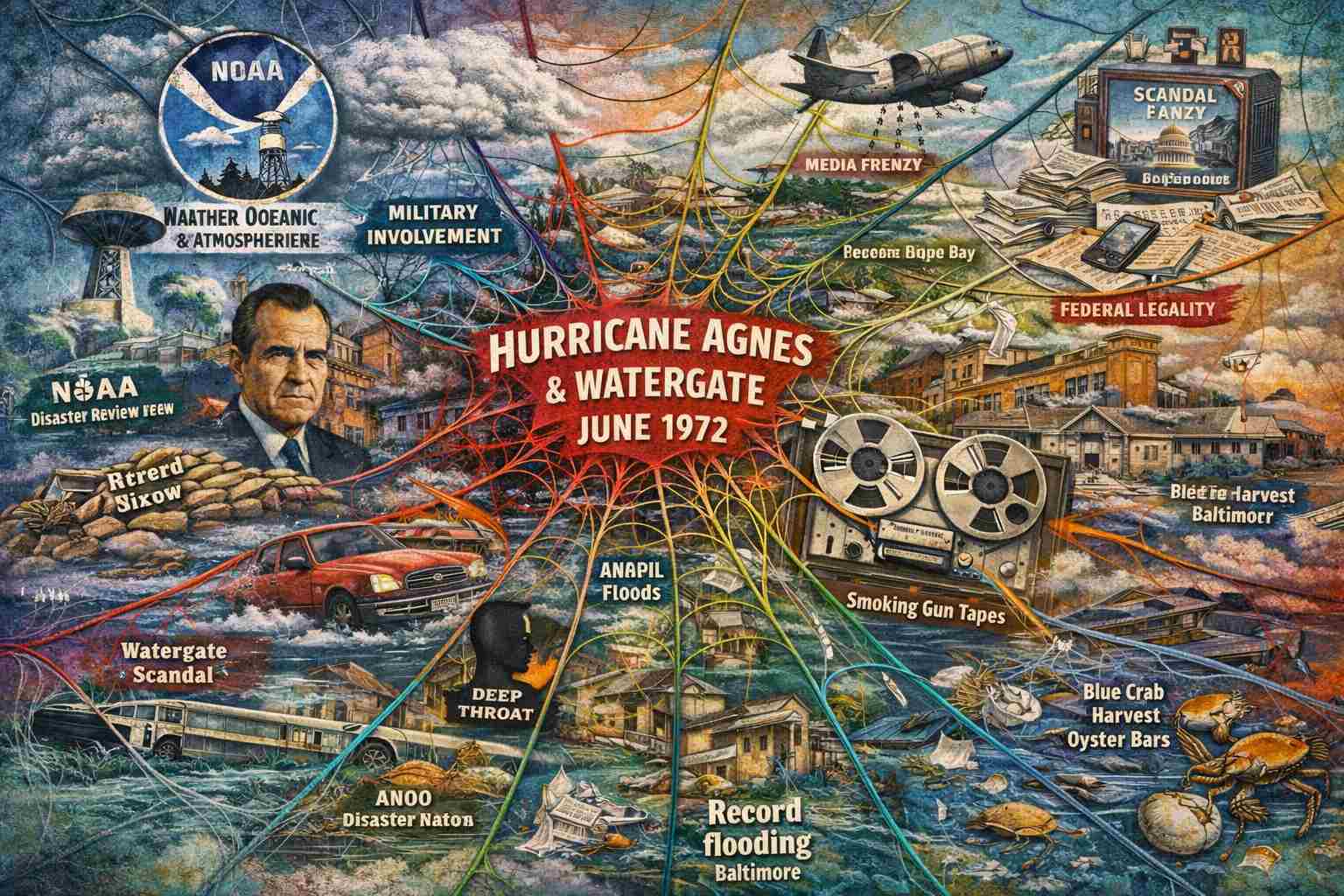
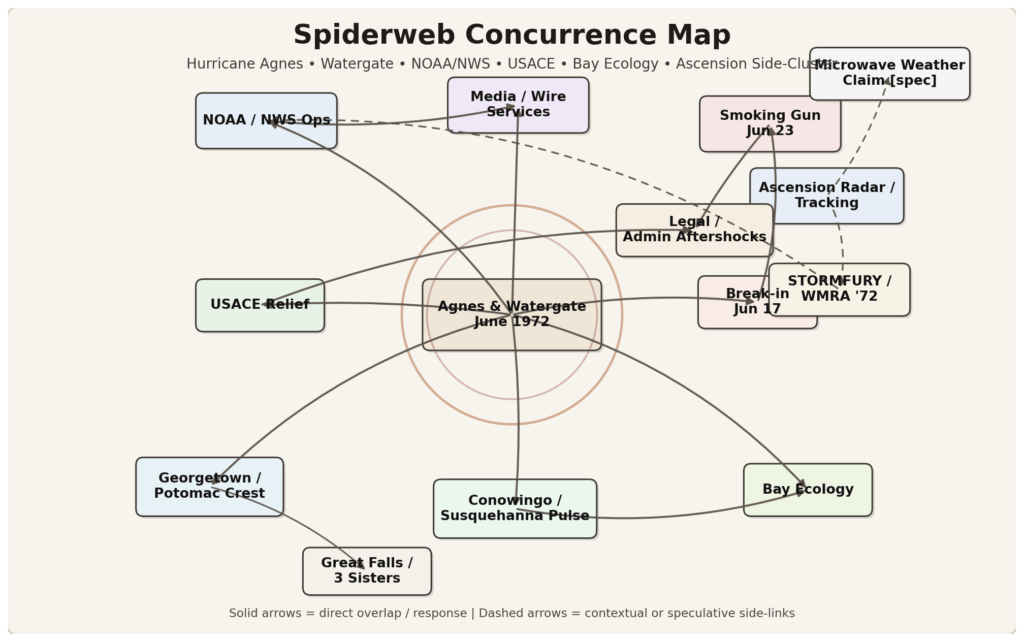
Spiderweb Concurrence Map: Hurricane Agnes, Watergate, NOAA/NWS, USACE, Bay Ecology, and Ascension Island Facilities
Executive summary
In late June 1972, two storylines overlapped in time, geography, and media bandwidth: Hurricane Agnes’ Mid‑Atlantic flooding (June 21–24) and the early Watergate escalation (June 17 burglary; June 23 “smoking gun” tape conversation).
The specific “concurrence” that’s most defensible is temporal and infrastructural: both events competed for attention inside the same Washington-region institutions and information channels (broadcast news desks, wire services, federal offices), while NOAA/NWS flood operations depended on those same dissemination pathways (NOAA Weather Wire, wire services, radio/TV rebroadcast).
Official post-event analysis of Agnes emphasizes warning/forecast systems, radar/satellite use, and mass-media relays—explicitly noting that wire services often gave “bulletin” status to warnings but that delays occurred between NWS issuance and broadcast. Meanwhile, primary Watergate records place the June 23 Oval Office discussion (later called the “smoking gun”) squarely inside that same week. The most meaningful “web” connections for a visual synthesis are therefore: (a) storm track → flooding impacts → emergency response logistics and engineering; (b) storm information flow → media gatekeeping and institutional delays; (c) downstream ecological shocks in the Chesapeake, including shellfish sanitation closures and longer-run submerged aquatic vegetation stress; and (d) higher‑level governance context in 1972–73 (Clean Water Act passage, disaster policy evolution, and the contemporary hurricane‑modification research milieu such as STORMFURY).
On the most speculative question—“weather‑altering microwave facilities” on Ascension Island—the strongest documentary trail supports tracking/telemetry/radar and communications, not weather control: Cold War missile‑tracking radar activity and later NASA deep‑space/spaceflight tracking infrastructure (mid‑1960s construction; DSN-to‑MSFN transfer in 1968) are well documented. Evidence that any Ascension microwave systems were intended to modify weather is not present in reliable primary/official records surfaced here.
Ascension Island installations and “microwave weather alteration”
What can be dated and sourced with high confidence
Cold War tracking/radar presence and “downrange” role (1950s–1970s). Official U.S. Air Force unit history summaries explicitly describe the Eastern Test Range’s downrange facilities and state that the organization operated downrange facilities at Ascension Island during 1951–1977 (and later periods). This establishes an institutional framework for radar/telemetry/communications operations on Ascension without implying weather modification.
Nike Zeus / high‑power radar activity (circa 1960). A U.S. Army photo (public domain) documents radome work for a Nike Zeus target‑tracking radar on Ascension dated 24 Aug 1960—this is a concrete “online by” marker for a microwave‑class radar installation.
NASA tracking station buildout at Devil’s Ashpit (late 1964–1965; operations thereafter). NASA’s official history volume (SP‑4233) notes planning in 1964, civil engineering upgrades beginning in late 1964, and construction following in February 1965 for the deep‑space antenna, operational about six months later, followed by another 9‑meter antenna for Apollo; it also describes NASA operating facilities while the Air Force provided logistical support.
DSN station established during 1965; transfer to MSFN in July 1968. A Jet Propulsion Laboratory Space Programs Summary explicitly footnotes: “The 30‑ft‑diam‑antenna station established by the DSN on Ascension Island during 1965… was transferred to the MSFN in July 1968.”
Catalog evidence for technical specifications documentation (1966). NASA’s Technical Reports Server record for “DSIF – Ascension Island” (publication date Jan 1, 1966) indicates a contractor report describing antennas, receiver systems, transmitters, instrumentation, and data handling procedures for the Ascension deep‑space instrumentation facility, with report numbers (JPL‑TM‑33‑284 / NASA‑CR‑89793). (The PDF download endpoint returned an access error in this environment; the catalog entry itself is still a strong archival pointer.)
Where “microwave facilities” do appear, but not as weather control
There are three distinct “microwave” buckets that frequently get conflated:
- Tracking radars and telemetry (active emitters; often high power; used for range safety and measurement). The Ascension chain-of-custody sources above support this category strongly.
- Satellite communications earth stations (microwave links to satellites; function is communications relay). A scanned 1967 informational booklet about the Ascension MSFN station describes an “earth‑satellite station” built in 1966 and operated by Cable & Wireless for Intelsat II communications for Apollo missions; its provenance is secondary (a scan hosted on an enthusiast site), so this is best treated as moderate confidence unless corroborated by a primary operator archive.
- Microwave radiometers (usually passive sensors that measure atmospheric brightness temperatures; modern climate research). This is not 1960–1980 Ascension content: it appears clearly in DOE ARM documentation for the LASIC campaign (Jun 2016–Oct 2017) that includes a microwave radiometer as part of atmospheric profiling instrumentation.
Direct answer: “When were the weather‑altering microwave facilities on Ascension Island brought online?”
No reliable primary or official source identified here describes an Ascension Island microwave installation whose purpose was to alter weather (in the sense of deliberately changing atmospheric dynamics as an operational objective). The best‑sourced microwave‑class facilities on Ascension in 1960–1980 are for missile/space tracking, telemetry, and communications, not weather control.
If you want to represent this in your image, the honest visual grammar is: place a node like “Microwave Wx [spec]” outside the main web, connect it with translucent dashed vapor strands to (a) “Stormfury,” (b) “WMRA ’72,” and (c) “Ascension Radar,” and stamp it with a “no primary evidence found” micro‑tag.
Are there records of Army/USAF/NOAA/military radar or meteorological installations on Ascension circa 1960–1980?
Yes for USAF/DoD range and radar/tracking infrastructure; yes for NASA tracking; no obvious NOAA operational installation trail in the sources reviewed.
USAF/DoD range & downrange facilities. USAF unit history descriptions directly assert operation of downrange facilities at Ascension within the Eastern Test Range framework and recount a continuing “vast network of radar, telemetry and communications instrumentation,” including downrange sites, as part of that institutional history.
NASA tracking and technical infrastructure. NASA’s own history publication and the JPL summary footnote provide specific construction and transfer dates for Ascension tracking facilities.
Army documentation (in the sense of a specific dated artifact). The best single “trace” is the dated U.S. Army photo of Nike Zeus target‑tracking radar radome work on Ascension in 1960.
NOAA / meteorological installations. NOAA is clearly present in the Agnes story through NWS operations, radar networks, and NOAA’s disaster survey reporting apparatus, but I did not surface a primary NOAA record indicating NOAA built or operated a dedicated Ascension meteorological “microwave” facility in 1960–1980.
Evidentiary strength assessment
- Strong (5/5): NASA Devil’s Ashpit construction timeline and DSN→MSFN transfer.
- Strong (4–5/5): DoD/USAF “downrange facility” institutional role (unit history pages) + specific 1960 Army photo artifact.
- Moderate (3/5): 1966 commercial earth-station claim via scanned booklet (credible but merits corroboration via operator archives or government contracting records).
- Weak (1/5): “Weather‑altering microwave” operational claim (no primary support identified in the reviewed archival/official sources).
It is vital to note that Woodward is strongly suspected if not confirmed CIA. That illuminates things in an entirely different light. Exopolitical forces were apparently hard at work vying to change world balance of power.